阿摩線上測驗
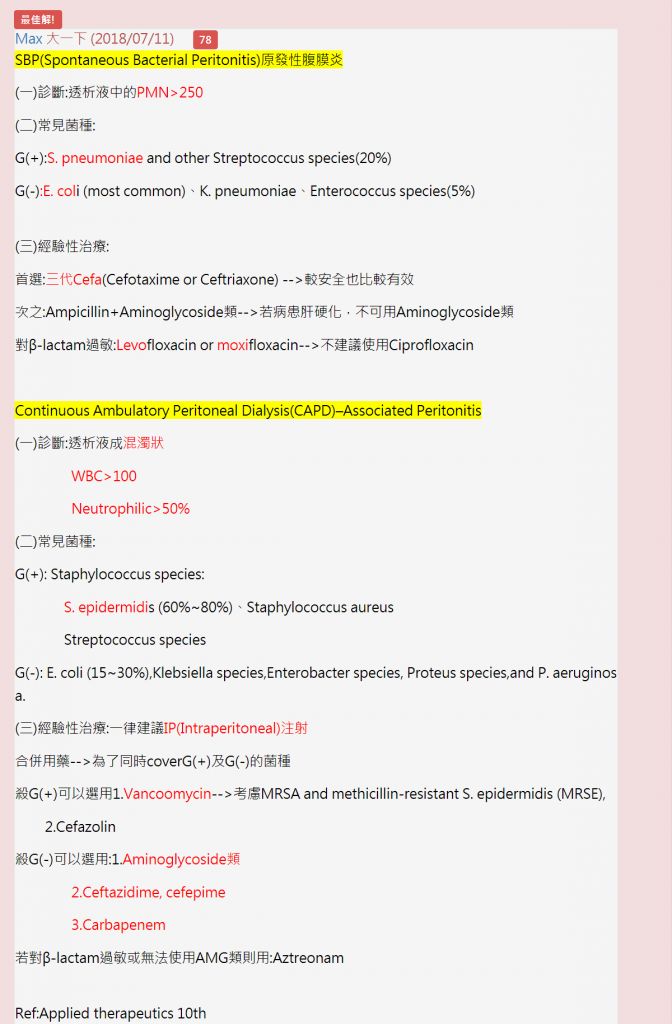
61.經腹膜透析液培養為Staphylococcus epidermidis infection,下列何者為最合適的治療藥品?
(A)steroids
(B)metronidazole
(C)vancomycin
(D)cefazolin
統計: A(5), B(691), C(1711), D(3270), E(0) #1837880
詳解 (共 10 筆)


根據最佳解:
「The increasing prevalence of vancomycin-resistant organisms has resulted in a shift in empiric therapy away from vancomycin, toward first-generation cephalosporins (cefazolin or cephalothin).」
由於臨床發現越來越多腹膜感染的菌株,對於Vancomycin都產生抗藥性。因此經驗性療法排除Vancomycin,而改用第一代Cepha(如cefazolin)來做為首選藥物。



是or cephalothin

樓上那個orncephalothin 是一個詞 還是or cephalothin?

Spontaneous bacterial peritonitis in adults: Treatment and prophylaxis
TREATMENT
In patients with suspected spontaneous bacterial peritonitis (SBP), empiric therapy should be initiated as soon as possible to maximize the patient's chance of survival.
However, antibiotics should not be given until ascitic fluid has been obtained for culture.
Most cases of SBP are due to gut bacteria such as Escherichia coli and Klebsiella, though streptococcal and staphylococcal infectionscan also occur. As a result, broad-spectrum therapy is warranted until the results of susceptibility testing are available. We prefer cefotaxime 2 g intravenously every eighthours because it has been shown to produce excellent ascitic fluid levels.
Indications for antibiotic therapy — Empiric therapy for SBP should be started in a patient with ascites who has one or more of the following findings :
●Temperature greater than 37.8°C (100°F)
●Abdominal pain and/or tenderness
●A change in mental status
●Ascitic fluid polymorphonuclear leukocyte (PMN) count ≥250 cells/mm3
Choice of antibiotic — Most cases of SBP are due to gut bacteria such as E. coli and Klebsiella; however, streptococcal and, infrequently, staphylococcal infections can also occur. As a result, relatively broad-spectrum therapy is warranted in patients with suspected ascitic fluid infection. Clinical trials directly comparing different regimens are limited, and no antibiotic or combination of antibiotics has been proven to be superior to other regimens for the treatment of SBP. Our preference is to use intravenous cefotaxime 2 g every eight hours for most patients because it produces excellent blood and ascitic fluid levels throughout the dosing interval. Alternatives include other third-generation cephalosporins and fluoroquinolones.
Third-generation cephalosporins — Several antibiotic regimens have been shown to be effective for the treatment of SBP, but trials directly comparing different antibiotic regimens are lacking. A third-generation cephalosporin is a reasonable choice for suspected SBP. Our preference is to give cefotaxime 2 g intravenously every eight hours. While ceftriaxone has been shown to prevent SBP in the setting of gastrointestinal hemorrhage in patients with cirrhosis, in our experience, cefotaxime is more effective than ceftriaxone for treating SBP. If ceftriaxone is used, patients should be given 2 g per day.
Other antibiotics — Other antibiotics can be used for the treatment of SBP. Whenever possible, the alternative antibiotic should have been studied for the treatment of SBP. Ciprofloxacin can be used for patients who cannot take a cephalosporin, although it does not penetrate into ascitic fluid to the same extent as cefotaxime. We give ciprofloxacin at a dose of 400 mg intravenously twice daily to patients with normal renal function.
Antibiotic resistance — A concern related to the choice of antibiotics is the emergence of resistant infections, especially in centers that use fluoroquinolones for SBP prophylaxis. Cefotaxime is appropriate treatment in patients who have been receiving SBP prophylaxis with a fluoroquinolone.
In settings where resistance to third-generation cephalosporinshas been documented, piperacillin-tazobactam or a carbapenemhas been used empirically as an alternative to cefotaxime, although there is less clinical experience. Further study on the efficacy of alternative antibiotic regimens is needed.
Duration of therapy — Trials have found that short-courses of treatment for SBP are effective. Many patients will respond to a treatment course of five days.
We treat most patients for five days, including patients who are bacteremic (as they did in the 5- versus 10-day trial). Only patients who grow an unusual organism (eg, pseudomonas, Enterobacteriaceae), an organism resistant to standard antibiotic therapy, or an organism routinely associated with endocarditis (eg, Staphylococcus aureus or viridans group streptococci) are initially considered for longer treatment. After five days, we reassess the patient. Treatment is discontinued if there has been the usual dramatic improvement. However, if fever or pain persists, paracentesis is repeated, and the decision to continue or discontinue treatment is determined by the PMN response:
●If the PMN count is <250 cells/mm3, treatment is stopped.
●If the PMN count is greater than the pretreatment value, a search for a surgical source of infection is undertaken.
●If the PMN count is elevated but less than the pretreatment value, antibiotics are continued for another 48 hours, and paracentesis is repeated.
Secondary bacterial peritonitis and polymicrobial infections — Patients with suspected secondary bacterial peritonitis should receive broader coverage with cefotaxime and metronidazole. A similar regimen should be used with polymicrobial bacterascites.

60、61、62應為題組。