所屬科目:轉學考-普通化學
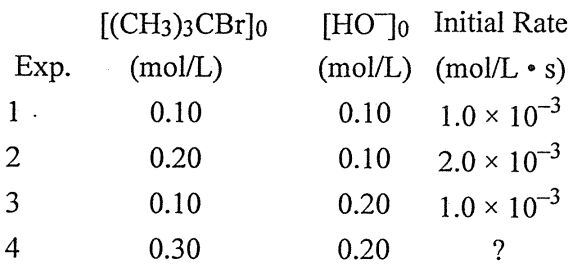
16. The reaction of (CH3)3CBr with hydroxide ion proceeds with the formation of (CH3)3COH. (CH3)3CBr(aq) + OH-(aq) → (CH3)3COH(aq) + Br-(aq)The following data were obtained at 55 ℃.What will the initial rate (in mol/L • s) be in Experiment 4? (A) 1.8 × 10⁻³ (B) 6.0 × 10⁻³ (C) 9.0 × 10⁻³ (D) 3.0 × 10⁻³ (E) none of these
17. Consider the reaction3A + B + C → D + Ewhere the rate law is defined as-= k[A]2[B][C]An experiment is carried out where [B]0 = [C]0 = 1.00 M and [A]0 = 2.46 × 10⁻⁴M. After 2.96 min, [A] = 3.20 × 10⁻⁵ M. What is the value of k? (A) 8.30 × 10⁷ L3/mol3 • s (B) 4.02 × 10⁻⁷ L3/mol3 • s (C) 2.14 × 10⁻⁵ L3/mol3 • s (D) 1.53 × 10² L3/mol3 • s (E) 9.18 × 10³ L3/mol3 • s
22. The nuclide Th is radioactive. When one of these atoms decays, a series of α- and β-particle emissions occurs, taking the atom through many transformations to end up as an atom of Pb. How many α particles are emitted in converting Th into Pb? (A) 8 (B) 10 (C) 4 (D) 6 (E) 2
23. Which reaction will produce an isotope of the parent nuclide? (A)Ac → β + ? (B) As + e→ ? (C)N → β+ ? (D) Br → n + ? (E) Po → He + ?
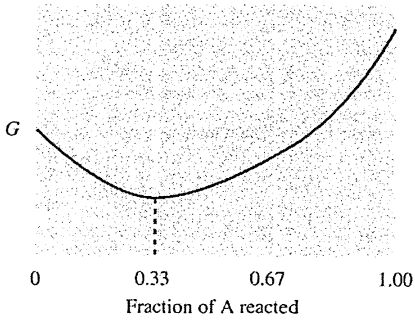
3.Consider the following diagram of free energy (G) versus fraction of A reacted in terms of moles for the reaction 2A(g) → B(g).Before any A has reacted, PA = 3.0 atm and PB = 0. Determine the sign of ΔGº and the value of K for this reaction. (6%)
 阿摩線上測驗
登入
阿摩線上測驗
登入
 = k[A]2[B][C]
 Th is radioactive. When one of these atoms decays, a series of α- and β-particle emissions occurs, taking the atom through many transformations to end up as an atom of
  Pb. How many α particles are emitted in converting
  Ac → β + ? (B)
  As + e→ ? (C)
 N → β+ ? (D)
  Br → n + ? (E)
  Po → He + ?