所屬科目:研究所、轉學考(插大)-有機化學
1. What hybridization do you expect the carbon atom of the following methyl carbocation to have? (A) sp (B)sp2 (C)sp3 (D) The carbon atom is not hybridized.
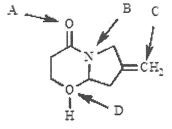
2. What atom would have a formal charge in the right structure?(A)(B)(C)(D)
3. Which of the following describes the relationship between the following two structures? (A) identical structures (B) resonance forms (C) constitutional isomers (D) different compounds with different compositions
8. Which of the following compounds is (are) achiral? (A) only I(B) only II (C) only I and II (D) only II and IIl (E) I, II, and III
9. What is the relationship between the following pair of structures? (A) They are enantiomers. (B) They are diastereomers. (C) They are constitutional isomers. (D) They are identical with different conformations.
12. Which of the following ions are aromatic species?
(A) I and III (B) II and IIl (C) II and IV (D) III and IV
14. Where would the compound shown below undergo bromination with Br2/FeBr3? (A) ortho/para position on ring I (B) meta position on ring l (C) ortho/ para position on ring 2 (D) meta position on ring 2
16. What is the IUPAC name of the following compound? (A) 3-bromo-2-methylcyclohexene (B) 1-bromo-2-methyl-2-cyclohexene (C) 6-bromo-1-methylcyclohexene (D) 2-bromo-I-methylcyclohexene
19. Identify the mechanistic pathways, respectively, for the products in the following reaction. (A) E1,SN1 (B) E1,SN2 (C) E2,SN1 (D) E2, SN2
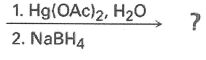
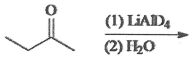
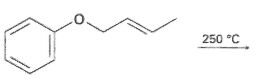
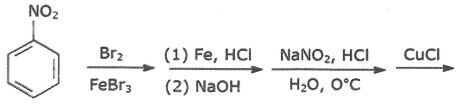
24. What is the product of the following reaction?
(A) (B)(C)(D)
25. What is the product of the following reaction? (A) (S)-1,2-propanediol (B)(R)-1,2-propanediol (C) racemic mixture of 1,2-propanediol (D) 1,3-propanediol
(b)
(c)
(d)
(e)
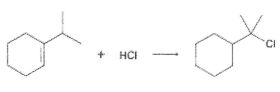
2. Addition of HC1 to l-isopropylcyclohexene yields a rearranged product. Propose a mechanism, showing the structures of the intermediates and using curved arrows to indicate electron flow in each step. (5 分)
(a)
 阿摩線上測驗
登入
阿摩線上測驗
登入
 (A) sp (B)sp2 (C)sp3 (D) The carbon atom is not hybridized.
 (A)(B)(C)(D)
 (A) identical structures (B) resonance forms (C) constitutional isomers (D) different
compounds with different compositions
(A) identical structures (B) resonance forms (C) constitutional isomers (D) different
compounds with different compositions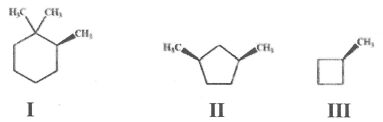 (A) only I(B) only II
(C) only I and II (D) only II and IIl
(E) I, II, and III
(A) only I(B) only II
(C) only I and II (D) only II and IIl
(E) I, II, and III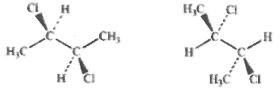 (A) They are enantiomers. (B) They are diastereomers.
(C) They are constitutional isomers.
(D) They are identical with different conformations.
(A) They are enantiomers. (B) They are diastereomers.
(C) They are constitutional isomers.
(D) They are identical with different conformations.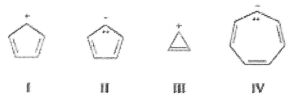 (A) I and III (B) II and IIl
(C) II and IV (D) III and IV
(A) I and III (B) II and IIl
(C) II and IV (D) III and IV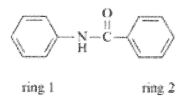 (A) ortho/para position on ring I (B) meta position on ring l
(C) ortho/ para position on ring 2 (D) meta position on ring 2
(A) ortho/para position on ring I (B) meta position on ring l
(C) ortho/ para position on ring 2 (D) meta position on ring 2 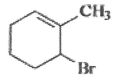 (A) 3-bromo-2-methylcyclohexene
(B) 1-bromo-2-methyl-2-cyclohexene
(C) 6-bromo-1-methylcyclohexene
(D) 2-bromo-I-methylcyclohexene
(A) 3-bromo-2-methylcyclohexene
(B) 1-bromo-2-methyl-2-cyclohexene
(C) 6-bromo-1-methylcyclohexene
(D) 2-bromo-I-methylcyclohexene (A) E1,SN1 (B) E1,SN2 (C) E2,SN1 (D) E2, SN2
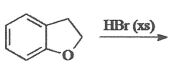 (A)
(A)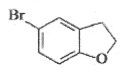 (B)
(B)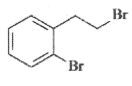 (C)
(C)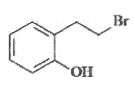 (D)
(D)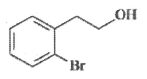
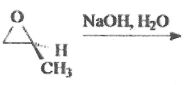 (A) (S)-1,2-propanediol (B)(R)-1,2-propanediol
(C) racemic mixture of 1,2-propanediol (D) 1,3-propanediol
(A) (S)-1,2-propanediol (B)(R)-1,2-propanediol
(C) racemic mixture of 1,2-propanediol (D) 1,3-propanediol