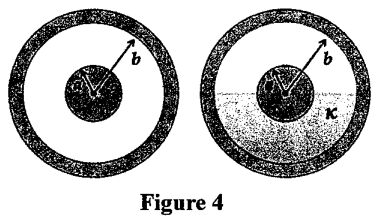
5. As shown in Figure 4, in cross section, a cylindrical capacitor of length L formed by two coaxial cylinders of radii a and b. Assuming L is much greater than b so that we can neglect the fringing of the electric field that occurs at the ends of the cylinders. The capacitor is charged in a circuit, and the electric potential difference between the two cylinders is V. The capacitor is then disconnected from the circuit. A liquid dielectric material of dielectric constant k is injected to the capacitor, and is only half filled. After filling the dielectric material, what is the electric potential difference between the two cylinders?
 阿摩線上測驗
登入
阿摩線上測驗
登入