 阿摩線上測驗
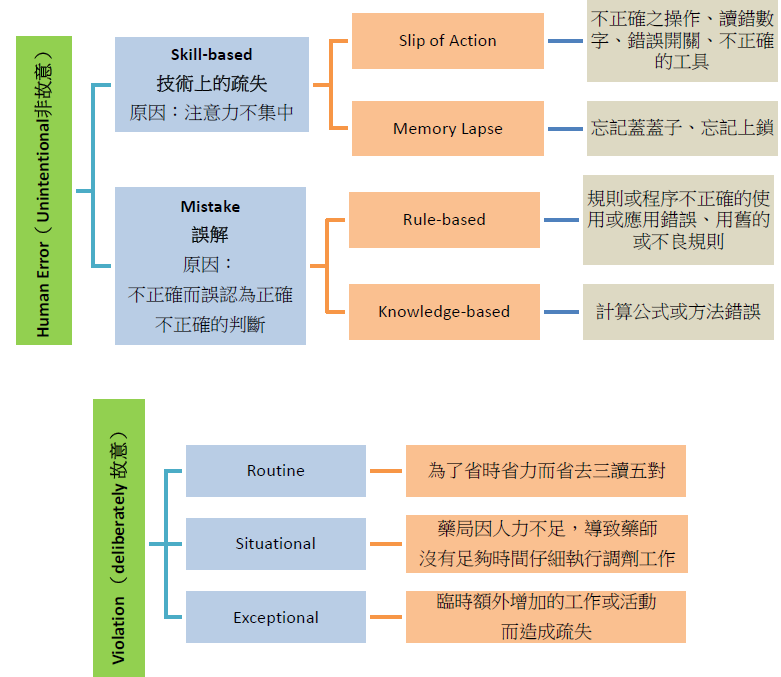
30.藥局因人力不足,導致藥師沒有足夠時間仔細執行調劑工作,而造成用藥疏失。此屬下列何種程序過失(procedural violations)?
(A)optimizing violations
(B)routine violations
(C)situational violations
(D)exceptional violations
答案:登入後查看
統計: A(504), B(800), C(2549), D(352), E(0) #722657
統計: A(504), B(800), C(2549), D(352), E(0) #722657
詳解 (共 4 筆)
Iris Lin
#1423200
389
1


莊欣霓
#1116187
Routine Violations result from automatic and sometimes unconscious behaviour. They are habitual actions (strong, but wrong, habits) accepted by the particular work group as normal business, and are often tolerated by the organisation and/or governing body. Employees will usually consider routine violations as low-risk to themself and the task. For example, airside drivers may always drive 10km/hr above the mandatory speed limit.
Situational Violations are the result of organisational and environmental factors that make it difficult for employees not to commit violations. These factors include time pressure, lack of supervision, poor ambient conditions (e.g. light, noise, heat), insufficient resources, and a negative culture. Technicians may find themselves “signing-off” completed work on an aircraft without acquiring the necessary supervisory cross-check. Either because of a lack of supervisors, or because the process takes too long.
Optimising Violations occur when people try to make a task more exciting or interesting to impress others or to relieve boredom. These are common when people are involved in long periods of monotonous work, such as monitoring tasks, or when the rules are restrictive or outdated. This can be characterised by bored and fatigued pilots during a quiet long-haul flight - let’s see what happens when we push this button!
Exceptional Violations are rare occurrences that take place in very unusual circumstances (e.g. emergencies, equipment failure). They can be the result of a conscious decision to violate or an instinctive reaction to the situation. Conscious decisions may include landing with an excessive tailwind on a long runway following an hydraulic systems failure, rather than risk further consequences during the time it takes to re-position for the preferred runway. Instinctive reactions fall much closer to the caveat that pilots may violate rules if it is safer to do so – i.e. continuing with an unstable approach to land following an uncontained engine failure.
Situational Violations are the result of organisational and environmental factors that make it difficult for employees not to commit violations. These factors include time pressure, lack of supervision, poor ambient conditions (e.g. light, noise, heat), insufficient resources, and a negative culture. Technicians may find themselves “signing-off” completed work on an aircraft without acquiring the necessary supervisory cross-check. Either because of a lack of supervisors, or because the process takes too long.
Optimising Violations occur when people try to make a task more exciting or interesting to impress others or to relieve boredom. These are common when people are involved in long periods of monotonous work, such as monitoring tasks, or when the rules are restrictive or outdated. This can be characterised by bored and fatigued pilots during a quiet long-haul flight - let’s see what happens when we push this button!
Exceptional Violations are rare occurrences that take place in very unusual circumstances (e.g. emergencies, equipment failure). They can be the result of a conscious decision to violate or an instinctive reaction to the situation. Conscious decisions may include landing with an excessive tailwind on a long runway following an hydraulic systems failure, rather than risk further consequences during the time it takes to re-position for the preferred runway. Instinctive reactions fall much closer to the caveat that pilots may violate rules if it is safer to do so – i.e. continuing with an unstable approach to land following an uncontained engine failure.
14
1