 阿摩線上測驗
4.相對於 Diamond and Plattner(1996)所稱「實質民主政體」(substantial democracy)而言,所謂的「選舉民主政體」(electoral democracy)具有下列何種特性?
(A)真正的競爭性
(B)多元主義滋長
(C)權力輪替
(D)有助反對黨興起的公民文化
答案:登入後查看
統計: A(4353), B(596), C(1438), D(650), E(0) #361243
統計: A(4353), B(596), C(1438), D(650), E(0) #361243
詳解 (共 10 筆)

Vivin Wu
#668834
Larry Diamond 以「選舉的民主」來形容﹐認為乃是當代民主最起碼的概念。(Diamond, 1996﹕21)這種程序上最起碼的政治民主必要因素包括﹕祕密投票、普選權、定期選舉、政黨競爭、結社承認等。(O'Donnelland Schmitter, l986﹕8)民主的程序原則雖不是民主政治的充分條件﹐卻是民主存在的必要條件。(cf. Schmitter and Kar1, l991﹕81)然而﹐假如民主被界定為上述Schumpeter 的模式﹐則中美洲許多軍事國家很容易符合這定義﹐就可能被歸類為民主國家﹐而遭受到一些批評﹔(Karl, 1990﹕22﹔cf. Monshipouri, 1995﹕15)甚至於被形容為只是半民主政體(semidemocraticregime)﹐因為它雖擁有競爭性的選舉形式﹐但卻缺乏自由民主政治所需之政治與公民自由實質內涵。(Schedler, 1998﹕93)
參考自第25頁: http://nccur.lib.nccu.edu.tw/bitstream/140.119/34386/6/26101506.pdf
167
5

Angela Huang
#1110658
就想中南美洲興新國家有競爭式的選舉(用Schumpeter 的定義分類就算是民主國家),但是卻沒有實質的民主。
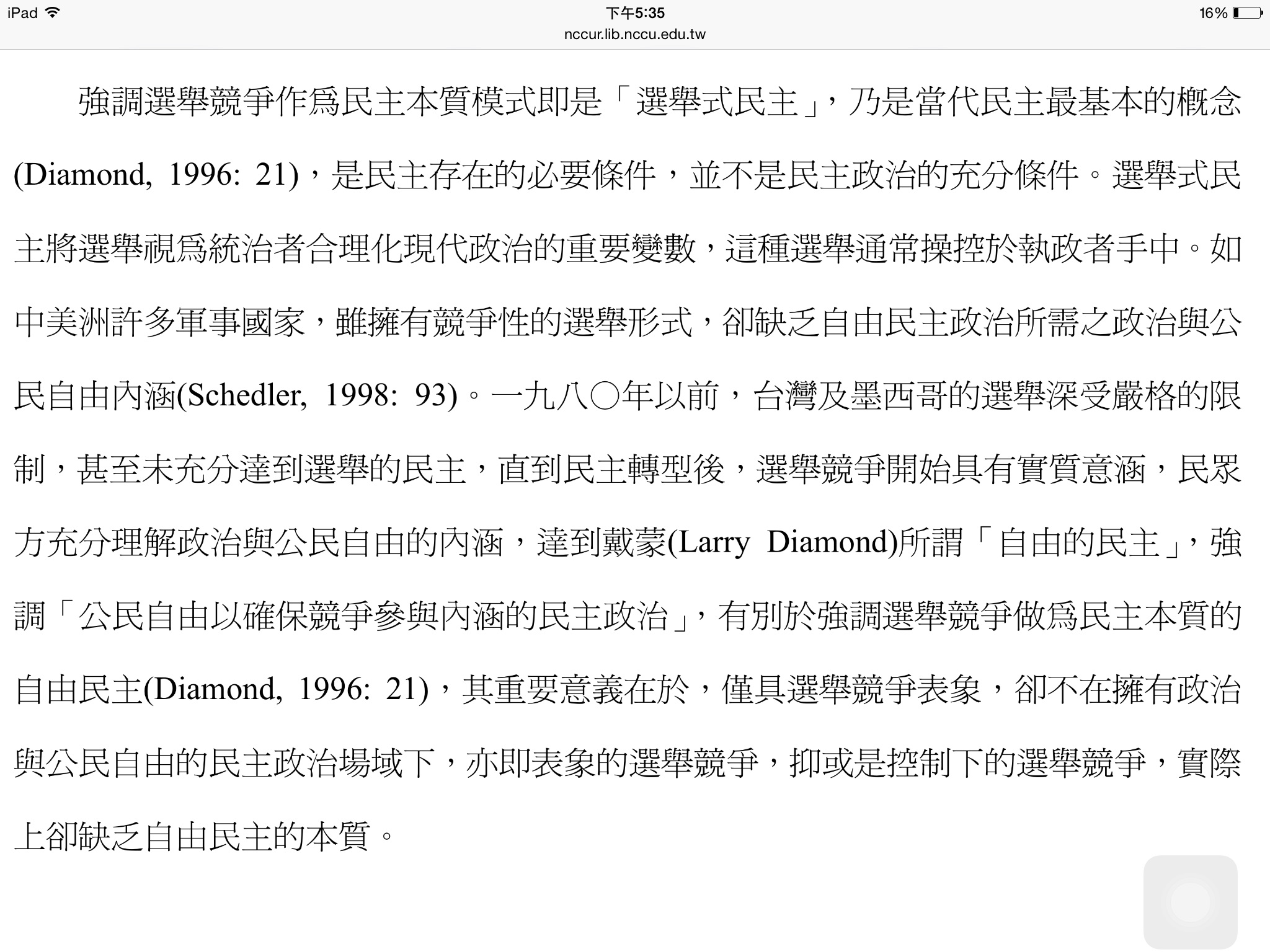
政大論文
http://nccur.lib.nccu.edu.tw/bitstream/140.119/37390/7/52504207.pdf
55
0
Daphne Fan
#641817
「選舉民主政體」(electoral democracy)不一定有 權力輪替
EX: 總統大選2008年民進黨換國民黨,之後2012年還是國民黨
50
4

喵喵
#1030660
此題千萬不要看最佳解,因為解得很奇怪。
選舉式民主 >>真正競爭 >>挾大量人民支持造成民粹 >>國家或行政元首以民粹為理由而不受國會控制>>民選獨裁(b多元主義不滋長) >>自此權力很難輪替了(c)。Ex.菲律賓馬可士/希特勒。
選舉式民主 >>真正競爭 >>挾大量人民支持造成民粹 >>國家或行政元首以民粹為理由而不受國會控制>>民選獨裁(b多元主義不滋長) >>自此權力很難輪替了(c)。Ex.菲律賓馬可士/希特勒。
45
5

新雅雅
#921729
選舉民主政體:著重在「競爭式的選舉」,但欠缺對於基本人權保障與政府治理機能的關注。
44
0
Peter Jay
#449300
民主下才有真正的競爭性及公開還有公平性可言
42
12
Allison Chen
#1338243
選舉民主政體著重在
>>>競爭式的民主選舉
但是欠缺實質人權保障
與政府治理機能的關注
38
1

小晴
#985262
選舉只能代表各個政黨公開.平等的競爭機會
但是競爭結果不一定是多元的
但是競爭結果不一定是多元的
可能為同一個政黨所壟斷
或可能不為政黨輪替
因此B.C不為其特徵
A為最佳解
A為最佳解
35
0

繆珺贑
#841174
101年普考的選擇考很多strange...
18
0
好麻煩
#622452
--
此題出於本篇論文 'In the name of democracy’ The paradox of democracy and press freedom in post-communist Russia
(Smaele, 2002)
節錄其中內容
At a minimum, democracy is a political system based on free, competitive and
regular elections.
This ‘electoral’ democracy presumes space for political opposition movements and political parties that represent a significant range of voter choice and whose leaders can openly compete for and be elected to positions of power in government (eg.Schumpeter, 1979).
最接近的答案是A,但選項D明顯有爭議
因為Diamond說的是公民社會 而非公民文化 兩者並不同
公民文化是Almond & Verba提出的
The concept of ‘liberal’ (eg. Diamond, 1996) or ‘substantial’democracy
(eg. Kaldor & Vejvoda, 1999) extends the key element of free
competition with a bunch of political and civil rights (freedom of speech, freedom of association, freedom of religion, etc.) and the notions of the rule of law, inclusive citizenship and civil society.
此題出於本篇論文 'In the name of democracy’ The paradox of democracy and press freedom in post-communist Russia
(Smaele, 2002)
節錄其中內容
At a minimum, democracy is a political system based on free, competitive and
regular elections.
This ‘electoral’ democracy presumes space for political opposition movements and political parties that represent a significant range of voter choice and whose leaders can openly compete for and be elected to positions of power in government (eg.Schumpeter, 1979).
最接近的答案是A,但選項D明顯有爭議
因為Diamond說的是公民社會 而非公民文化 兩者並不同
公民文化是Almond & Verba提出的
The concept of ‘liberal’ (eg. Diamond, 1996) or ‘substantial’democracy
(eg. Kaldor & Vejvoda, 1999) extends the key element of free
competition with a bunch of political and civil rights (freedom of speech, freedom of association, freedom of religion, etc.) and the notions of the rule of law, inclusive citizenship and civil society.
14
3