題組內容
13. (10%) Consider a linear trainsformation L:P2 →>R2 defined by L(p(x):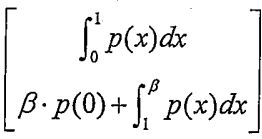 , for every p(x)
 , with β>1.
(A) (4%) Find all possible values of β such that , the inverse of L, does not exist.
 阿摩線上測驗
登入
阿摩線上測驗
登入
13. (10%) Consider a linear trainsformation L:P2 →>R2 defined by L(p(x):, for every p(x), with β>1.
(A) (4%) Find all possible values of β such that, the inverse of L, does not exist.