 阿摩線上測驗
題組內容
3.(11%)下面的問题共有二個子題,(1)子題要清楚地寫山證明,(b)子題只要簡短扼要地回答
提問即可。
Let A be any matrix in  . Then, since rank(A) = dim(R(A)), the dimension of range of A, and
R(A) = R(AAT), we have the result rank(A) = rank(AAT). Therefore, when replacing A by its QR factorization, we get rank(A) = rank(QRRTQT).
. Then, since rank(A) = dim(R(A)), the dimension of range of A, and
R(A) = R(AAT), we have the result rank(A) = rank(AAT). Therefore, when replacing A by its QR factorization, we get rank(A) = rank(QRRTQT).
(a) (6%) Please continue the argument to derive the result rank(A) = rank(R).
(接下來前段是背景知識介紹,之後才是提問)Insthq
given , instead of using the elementary row operations (i.e. the Gauss eliminations) to
manipulate the equation, we may also apply the QR factorization to the equation to get QRx = b,
which implies further QT QRx = QTb. Since QTQ = In, it gives Rx = QTb. Thus, according to the
result of (a), when all columns of A are linearly independent, the square matrix R is nonsingular and
so the solution x =
, instead of using the elementary row operations (i.e. the Gauss eliminations) to
manipulate the equation, we may also apply the QR factorization to the equation to get QRx = b,
which implies further QT QRx = QTb. Since QTQ = In, it gives Rx = QTb. Thus, according to the
result of (a), when all columns of A are linearly independent, the square matrix R is nonsingular and
so the solution x = b is obtained.
It seems that we may summarize the above argument as the following statement:
b is obtained.
It seems that we may summarize the above argument as the following statement:
Given , where all columns of A are assumed linearly independent, then
solution to the equation Ax = 6 can always be computed from x =
, where all columns of A are assumed linearly independent, then
solution to the equation Ax = 6 can always be computed from x = , where Q and R are
matrices obtained from the QR factorization of A.
, where Q and R are
matrices obtained from the QR factorization of A.
However, the simple example shows that the summary is incorrect because, according
to the summary, the solution is x =
shows that the summary is incorrect because, according
to the summary, the solution is x =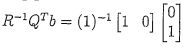 =0 and obviously it does not
satisfy the original equation.
=0 and obviously it does not
satisfy the original equation.