1. Researchers hypothesized that ob and db genes participate in a hormone pathway that suppresses appetite when caloric intake is sufficient. To test this hypothesis, they measured the mass of young mice ("subject mice") of various genotypes and surgically linked the circulatory system of each subject mouse to that of a partner mouse (parabiosis). This procedure ensured that any long-lasting substance circulating in the bloodstream of either mouse would be transferred to the other, but not the glucose or fatty acids that metabolized quickly. No new nerve growth was found between the two mice. All of the subject mice were given unlimited access to food and water. After eight weeks, the researchers again measured the mass of each subject mouse.
The table shows the data from the experiment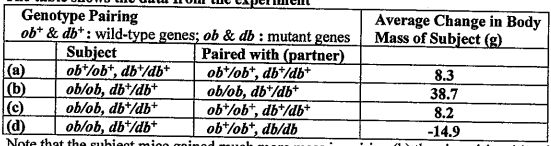
Note that the subject mice gained much more mass in pairing (b) than in pairing (a), whereas the subject mice in pairing (d) lost mass. It has been known that the ob+ gene produces the hormone leptin in adipose cells, and the db gene produces the receptors for leptin in some tissues. Give an explanation for the result of pairing (d) about the change in body mass of subject mice and the expected change in body mass of paired partner mice.
 阿摩線上測驗
登入
阿摩線上測驗
登入