所屬科目:研究所、轉學考(插大)◆普通化學
1. (a) For the hypothetical reactions 1 and 2, K₁ = 10² and K₂ = ; Please calculate K₃ value.
1. A₂(g) + B₂(g) ⇌ 2AB(g) K₁
2. 2A₂(g) + C₂(g) ⇌ 2A₂C(g) K₂
3. A₂C(g) + B₂(g) ⇌ 2AB(g) + (1/2)C₂(g) K₃ = ?
(b) Calculate the ratio of the change in momentum per wall impact for Ar(g) to that for He(g) if the gases are at the same temperature and pressure. (He : 4.0 ; Ar : 40.0)
2. (a) A 0.10 M solution of the salt NaA has pH = 9.0. Calculate for the acid HA.
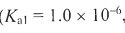
(b) Calculate the pH when 200.0 mL of a 1.00 M solution of H₂A (Kₐ₁ = 1.0 × , ) is titrated with the 100 mL of 1.00 M NaOH.
3. (a) What is Henry's law? Use this law to explain the fizzing when opening a can of soda.
(b) Draw the phase diagram of CO₂ the T₃ (triple point: 5.1 atm, -56°C) and use this phase diagram to explain why only sublimation occurs at 1.0 atm.
4. (a) Why is the vibration frequency of C-H bond at 2850-3300 higher than that of C-O bond at 1080-1300 ?
(b) Draw and brief describe a ¹H-NMR spectrum of the CH₃CH₂-Br. (including the internal standard TMS, chemical shift and spin-spin coupling)
5. (a) Derive the integrated rate law of second-order reaction.
(b) Why is the reaction in the following plot a first-order reaction? and also calculate the rate constant of this reaction.
(1). Internal energy at 27 °C,
(2). Cp ;
(3). ∆S = ? when the volume changes from V to 4V at T = 50°C.
(4). What is the potential energy at 50°C? (gas constant = R; 10%)
7. (a) Write the Schrödinger equation for the particle in a box.
(b) What is the energy of an electron with the mass mₑ confined in a box with a length of L at the lowest energy level.
(c) As the length of the nanoparticles increases, how the energy gap (ΔΕ) changes? (no change, increase or decrease?); why?
8. Use the molecular orbital model and draw MO energy-level diagrams to predict the magnetism and bond order of NO molecule and ion.
9. (a) Please draw all the structural and geometric isomers are there of chloropropene?
(b) What compound does the oxidation of secondary alcohols results in?
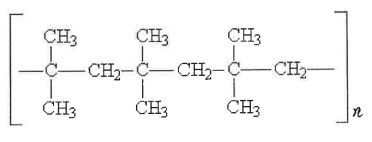
(c) What monomer(s) is (are) needed to produce the following polymer?
10. (a) Please use the crystal field model to predict how many unpaired electrons are there in a complex ion having a d⁶ electron configuration and an octahedral geometry in the weak-field case? (4%)
(b). Please use the crystal field model to predict how many unpaired electrons are found in Mn(NH₃)₄³⁺ (tetrahedral)? (Mn: 4s²3d⁵) (4%)
(c) Which transition metal is a component of vitamin B₁₂? (2%)
 ; Please calculate K₃ value.
  阿摩線上測驗
登入
阿摩線上測驗
登入
 for the acid HA.
  ,
,  ) is titrated with the 100 mL of 1.00 M NaOH.
  higher than that of C-O bond at 1080-1300
  ?
? 
 energy level.
  ion.
ion.