阿摩線上測驗
登入
首頁
>
研究所、轉學考(插大)-普通生物學
> 115年 - [無官方正解]115 國立臺灣大學_ 碩士班招生考試試題:普通生物學(A)#137686
115年 - [無官方正解]115 國立臺灣大學_ 碩士班招生考試試題:普通生物學(A)#137686
科目:
研究所、轉學考(插大)-普通生物學 |
年份:
115年 |
選擇題數:
33 |
申論題數:
21
試卷資訊
所屬科目:
研究所、轉學考(插大)-普通生物學
選擇題 (33)
[2pt] 1. Which of the following statements about the plant cell wall is the most incorrect?
((A) It provides mechanical support and restricts changes in cell shapе.
((B) It allows plant cells to rapidly migrate, like animal cells, to form organs.
((C) It influences the direction of cell expansion and contributes to organ morphogenesis.
((D) It can support intercellular communication through plasmodesmata.
((E) The cell wall can participate in cell-to-cell signaling by serving as a platform for signaling molecules and receptors.
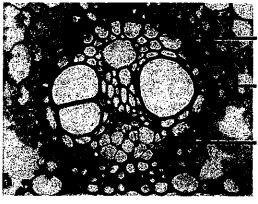
[2pt] 2. In a cross-section of a vascular bundle, Tissue X contains large hollow cells
with thickened walls and no cytoplasmic contents. Tissue Y contains living conducting
cells with associated small nucleated cells. Tissue X and Tissue Y are most likely:
((A) Tissue X = phloem, Tissue Y = xylem
((B) Tissue X = cortex, Tissue Y = epidermis
((C) Tissue X = xylem, Tissue Y = phloem
((D) Tissue X = cambium, Tissue Y = cork
[2pt] 3. Long-distance transport in phloem is best explained by:
((A) tension-driven flow caused by leaf transpiration
((B) diffusion driven by random molecular motion
((C) buik flow driven by hydrostatic pressure differences between source and sink
((D) active transport of sucrose through xylem vessels
[2pt] 4. Which of the following best explains why plants can exhibit high developmental plasticity?
((A) Plant cells can freely migrate to rearrange germ layers.
((B) Plant development is independent of environmental conditions.
((C) Plants lack signaling systems.
((D) Plant organ formation relies mainly on the orientation of cell division and patterns of cell expansion, rather than cell
migration.
5.
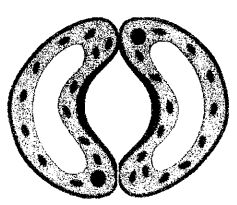
[2pt] 5.1 The figure shows a pair of guard cells with an open stomatal pore. Which
condition best explains this state?
((A) Guard cells have low (more negative) solute potential (Us), water enters guard
cells, and the stomata open.
((B) Guard cells have high (less negative) solute potential ('s), water leaves guard
cells, and the stomata open.
((C) Guard cells have high (less negative) water potential (Ww) than surrounding
cells, so water exits guard cells and the stomata open.
((D) Guard cells have low (more negative) pressure potential (p), which directly
forces the stomatal pore to open.
[2pt] 5.2 Which of the following changes would most directly promote the stomatal state shown in the figure?
((A) ABA signaling increases, triggering ion efflux from guard cells.
((B) K+ uptake into guard cells increases, leading to water influx.
((C) Sugar unloading from phloem into guard cells decreases, lowering s.
((D) CO2 concentration inside the leaf increases, triggering stomatal opening
[2pt] 6. Under drought stress, which sequence best represents the early events leading to stomatal closure?
((A) Water loss → guard cell turgor ↑→ stomata open → АВА ↑
((B) АВА ↑→ ion efflux from guard cells → guard cell turgor↓→ stomata close
((C) Photosynthesis↑ sugar ↑→guard cell turgor ↑→ stomata close
((D) Root pressure ↑→ xylem pressure ↑→ stomata close
[2pt] 7. Which statement best reflects a typical feature of plant hormone signaling?
((A) Each hormone triggers a single, specific physiological response across all tissues.
((B) A hormone always produces the same transcriptional response regardless of environmental conditions.
((C) Hormone action is independent of dosage; only presence/absence matters.
((D) Plant hormones act only locally and cannot function as systemic signals.
((E)The same hormone can produce different outcomes depending on tissue type, developmental stage, and receptor/signaling
context.
[2pt] 9. Based on the figure, which statement best explains shoot phototropism?
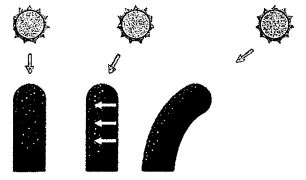
((A) Auxin accumulates on the lit side, increasing cell division, causing bending((B) Auxin accumulates on the shaded side, increasing cell elongation, causing bending toward light.
((C) Auxin accumulates on the lit side, increasing cell elongation, causing bending toward light.
((D) Auxin is evenly distributed, and bending is caused mainly by cell division differences.
((E) Auxin accumulates on the shaded side, decreasing cell elongation, causing bending.
[2pt] 10.Which of the following is LEAST likely to be a direct cause of high developmental plasticity in plants (e.g., changes in
root system architecture)?
((A) Changes in the orientation of cell division
((B) Changes in the rate and direction of cell elongation
((C) Large-scale migration of cells to new positions
((D) Integrated regulation by hormonal and nutrient signaling
((E) Changes in meristem activity leading to altered organ initiation patterns
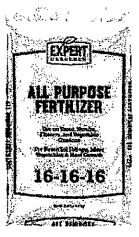
[2pt] 11. A fertilizer label "16-16-16" indicates the percentage by mass of N, P2O5,and K₂O.
Which statement is the most accurate interpretation for plant growth?
(A) A 16-16-16 fertilizer maximizes growth because all three nutrients are present in equal
amounts.
(B) The fertilizer provides equal amounts of elemental N, P, and K, so deficiencies are
impossible.
(C) Plant growth response depends on which nutrient is limiting; adding a balanced fertilizer
may not increase growth if another nutrient (e.g., Fe) is limiting.
(D) Phosphorus and potassium are not essential nutrients because they can be replaced by
nitrogen.
(E) The numbers indicate the soil pH required for optimal uptake.
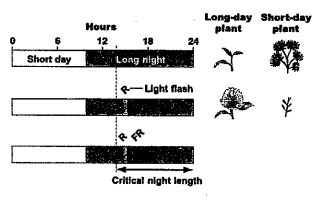
[2pt] 12. The figure shows a short-day condition (long night) and the effect of a
night interruption with a brief red light pulse (R), followed by far-red light (FR) (row
3). Which option BEST predicts flowering outcomes for the long-day plant and
short-day plant in row 3?
ALL PURPOSE
TERTRIZ
16-16-16
Hours Long-day plant Short-day lant
6 18 24
Short day Long night
-Light flash
((A) Long-day plant does not flower; short-day plant flowers because FR pulse
reverses the effect of the R pulse.
((B) Short-day plant flowers in row 3 because the day length is still short, and shortday plants require short days to flower. Critical night length
((C) Long-day plant flowers; short-day plant does not flower because the red light night-break shortens the effective night length.
((D) Long-day plant does not flower; short-day plant flowers because the day length remains short.
((E) Long-day plant flowers; short-day plant flowers because both receive some light during the night
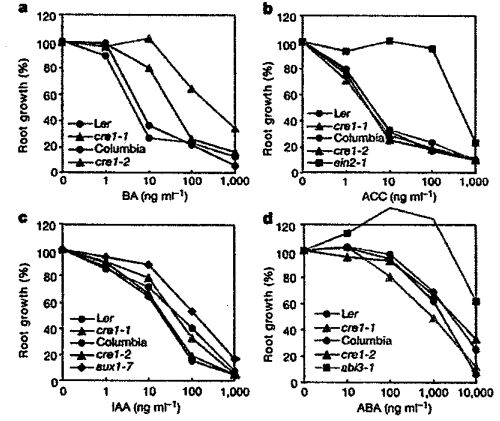
[2pt] 20. Based on panel (a), what is the effect of increasing
benzyladenine (BA; a cytokinin) concentration on Arabidopsis
root growth in wild-type plants?
[Note] Ler is the WT background for cre1-1, while Columbia is
the background for cre1-2.
((A) Root growth increases with increasing BA
((B) Root growth decreases with increasing BА
((C) Root growth is unaffected by BА
((D) Root growth first decreases then increases
V. Multiple-Choice Questions (20%, 1pt per question)
※注意:請於試卷內之「非選擇題作答區」依序作答,並應註明作答之大題及小題題號。
1. The blind spot in the human retina is the location that has the collected axons of
(A) ganglion cells; (B) bipolar cells; (C) primary visual cortex; (D) optic chiasma; (E) lateral geniculate nuclei
2. What structures would neurobiologists look for if they are interested in determining if an animal can see in color?
(A) opsins; (B) electroreceptors; (C) pupil; (D) lens
3. The pacemaker cells are found in what structure?
(A) sinoatrial node; (B) the ventricles; (C) left atrium; (D) pulmonary veins; (E) aorta
4. Ovulation is the follicular response to a burst of secretion of
(A) luteinizing hormone (LH); (B) progesterone; (C) inhibin; (D) prolactin; (E) estradiol
5. During metamorphosis, a tadpole's tail is reduced in size by the process of
(A) regeneration; (B) apoptosis; (C) meiosis; (D) oxidative phosphorylation; (E) re-differentiation
6. Which of the four muscular chambers of the human heart directly propels blood into the pulmonary circulation?
(A) right atrium; (B) right ventricle; (C) left atrium; (D) left ventricle
7. For a neuron at rest with a membrane potential of-65 mV, an increase in the movement of potassium ions out of that neuron's
cytoplasm would result in the_
(A) depolarization of the neuron
(B) hyperpolarization of the neuron
(C) replacement of potassium ions with sodium ions
(D) replacement of potassium ions with calcium ions
(E) neuron switching on its sodium-potassium pump to restore the initial conditions
8. Deafness caused by loud sounds often results from damage to which receptor cells?
(A) thermoreceptors; (B) mechanoreceptors; (C) chemoreceptors; (D) electroreceptors; (E) nociceptors
9. What would happen to people exposed to a chemical warfare agent that blocked acetylcholine from binding to muscle
receptors?
(A) Action potentials would be continuously generated, causing convulsive muscle contractions.
(B) Muscle contractions would be prevented, causing paralysis.
(C) Muscle contractions could still occur, but relaxation of the muscle would be impaired.
(D) Action potentials would be continuously generated, causing convulsive muscle contractions; muscle contractions would then
be prevented, causing paralysis.
10. After being produced in the testes, sperm mature further in a structure called the
(A) vas deferens; (B) epididymis; (C) prostate; (D) seminal vesicle.
11. Adaptive immunity is based upon
(A) traits common to groups of pathogens
(B) antigen-specific recognition;
(C) maternal provision of antibodies to offspring
(D) plants being exposed to new pathogens
(E) having exhausted all options for innate immunity responses
12. Cells move to new positions as an embryo establishes its three germ-tissue layers during
(A) determination; (B) cleavage; (C) fertilization; (D) induction; (E) gastrulation
13. The umami receptor in the sense of taste detects
(A) glucose; (B) sodium ions; (C) potassium ions; (D) hydrogen ions; (E) the amino acid glutamate
14. Which of the following is TRUE of the cloning experiment that resulted in Dolly the sheep?
(A) Dolly was genetically identical to the egg-cell donor.
(B) Dolly was cloned by fusing an egg with an embryonic stem cell.
(C) Dolly was infertile, which indicated incomplete nuclear reprogramming.
(D) Dolly was cloned by using a differentiated cell fused to an egg from another breed of sheep.
(E) Dolly was cloned by fusing the nuclei from two separate eggs harvested from the same individual.
15. What type of blood vessels has the slowest velocity of blood flow?
(A) arteries; (B) arterioles; (C) veins; (D) capillaries
16. Heart rate will increase in the presence of increased
(A) low-density lipoproteins; (B) immunoglobulins; (C) erythropoietin; (D) epinephrine; (E) platelets
17. Myocardial infarction occurs when
(A) arteries harden or lose their elasticity
(B) the electrical control of the heart leads to an elevated heart rate
(C) the heart stops
(D) blockage of blood vessels prevents adequate blood flow to the heart
18. Mechanoreceptors that react to changes in pressure are part of the
(A) human sense of taste; (B) pain receptors in birds; (C) human sense of smell; (D) lateral line systems in fish;
(E) eyes in arthropods
19. CD4 and CD8 are
(A) proteins secreted by antigen-presenting cells
(B) receptors present on the surface of natural killer cells
(C) T-independent antigens
(D) molecules present on the surface of T cells where they interact with major histocompatibility (MHC) molecules
(E) molecules on the surface of antigen-presenting cells where they enhance B-cell activity
20. An advantage of asexual reproduction is that it
(A) allows the species to endure long periods of unstable environmental conditions
(B) enhances genetic variability in the species
(C) enables the species to flourish in stable habitats that are favorable to that species
(D) produces offspring that respond effectively to new pathogens
(E) allows a species to easily rid itself of harmful mutations
申論題 (21)
[1pt each] 8. Please choose the best term from the following list for questions 8.1 to 8.4:
(A) Apoplastic route
8) Casparian strip/ Endodermis barrier
(C) Cortex
(D) Phloem
(E) Plasmodesmata
F) Symplastic route
G Transmembrane route
H) Xylem
8.1
8.2
8.3
8.4
I. True/False Questions (5%) ※ 注意:請於試卷內之「非選擇題作答區」標明題號依序作答。
[1pt] 13. Plants lack a nervous system; therefore, long-distance signal transmission is impossible in plants.
[1pt] 14. Most mature xylem vessels are dead cells, yet they can still transport water.
[1pt] 15. Plant phototropism mainly results from stronger photosynthesis on the illuminated side, causing that side to grow
faster.
[1pt] 16. In most cases, stomatal opening and closing are determined by osmotic regulation and turgor pressure changes in
guard cells.
[1pt] 17. Plant organ morphogenesis mainly depends on the orientation of cell division and cell elongation, rather than cell
migration.
II. Short Answer Questions ※ 注意:請於試卷內之「非選擇題作答區」依序作答
The figure (Figure 1 in Inoue et al., 2001) shows tissue culture responses across a matrix of
auxin (NA(A) and cytokinin (kinetin) concentrations for (a) wild type and (b) a mutant. In wild
type, increasing kinetin promotes shoot formation, whereas the mutant shows a strongly
altered response to kinetin.
[3pt] 18. Which receptor/signaling pathway is the mutant most likely defective in?
[3pt] 19. Briefly explain your reasoning using evidence from the figure (i.e.,how the
phenotype changes across kinetin/NAA conditions).
n the questions below, "insensitive" means the mutant shows
a weaker response than wild type (WT) at the same hormone
dose (i.e., root growth is less inhibited and remains higher than
WT). In contrast, "hypersensitive" means the mutant shows a
Root growth
(96)
0-cra1-1 -Columbi
20cre1-2 8ux1-7
1 10 100 1,000
IAA (ng mi-y
Root growth (%) --cre?-1 -Columbia cre1-2 -ab/3-1
10 100 100 100 1,000 10,000
ABA (ng mlstronger response than WT (i.e., root growth is more strongly inhibited and becomes lower than WT). If the mutant doseresponse curve largely overlaps with WT across concentrations, describe it as "no major change.
[2 pt] 21. Based on panel (b), compared to WT, cre1 mutants are to AC((C) (insensitive | hypersensitive | no major change)
[2 pt] 22. Based on panel (c), compared to WT, cre1 mutants are to IA((A) (insensitive | hypersensitive | no major change)
[2 pt] 23. Based on panel (d), compared to WT, cre1-2 mutants are _ to AB((A) (insensitive | hypersensitive | no major change)
[3pt] 24.Based on panels (a-d), does CRE1 most likely function as a hormone receptor/signaling component that is specific
(mainly for one hormone class) or general (required for multiple hormone responses)? Briefly justify your answer using the
figure
. Essay questions (30%)
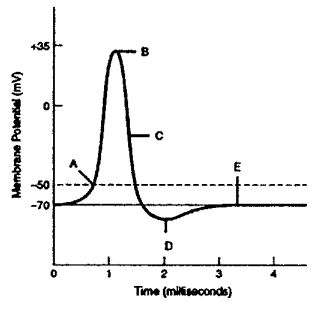
1.Refer to the following graph of an action potential to answer the questions below.
Identify the ions responsible for controlling each phase A-E of the action potential, and briefly explain their roles. (10pt)
2. Explain how the human endocrine system regulates blood glucose and blood calcium homeostasis. (10pt)
Compare these two homeostatic mechanisms with respect to:
(1) the major hormones involved
(2) the target organs
(3) the negative feedback mechanism
3.escribe the basic principles of CRISPR/Cas9 genome editing, and explain how DNA repair pathways influenceexperimental outcomes in gene function studies.
In addition, provide at least two examples of biomedical research or clinical applications of this technology. (5pt)
4.Explain the sliding filament model of muscle contraction, and describe how this model accounts for structural changes in the
sarcomere during muscle contraction and relaxation. (5pt)
相關試卷
115年 - 115 國立臺灣大學_ 碩士班招生考試試題:普通生物學(B)#137620
115年 · #137620
114年 - 114 高雄醫學大學_學生轉系考試試題:普通生物學#129767
114年 · #129767
114年 - [無官方正解]114 臺灣綜合大學系統_學士班轉學生聯合招生考試試題:普通生物學#129348
114年 · #129348
114年 - [無官方正解]114 國立臺灣大學_轉學生招生考試﹕普通生物學(B)#128203
114年 · #128203
114年 - [無官方正解]114 國立臺灣大學_轉學生招生考試﹕普通生物學(B)#128202
114年 · #128202
114年 - [無官方正解]114 國立臺灣大學_轉學生招生考試試題:普通生物學A#128200
114年 · #128200
114年 - 114 台灣聯合大學系統_學士班轉學生考試試題:普通生物學#128197
114年 · #128197
114年 - 114 國立臺灣大學_碩士班招生考試試題:普通生物學(B)#125980
114年 · #125980
114年 - 114 國立臺灣大學_碩士班招生考試試題:普通生物學(A)#125978
114年 · #125978
113年 - 113 國立臺灣大學_轉學生招生考試:普通生物學(B)#125304
113年 · #125304