阿摩線上測驗
登入
首頁
>
研究所、轉學考(插大)-流體力學
>
110年 - 110 國立臺灣大學_碩士班招生考試_海洋所物理與化學與地物組(3組聯招):流體力學(H)#100948
> 申論題
題組內容
3. Applications (30 points)
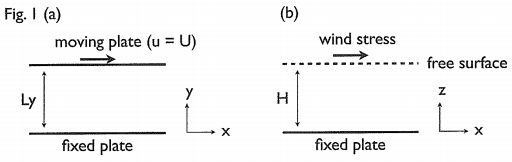
(b) Following (a), solve for the velocity field and estimate the shear force per unit area acting on the fixed plate. (8 points)
相關申論題
(a) Write down the statement of mass conservation (i.e. the continuity equation) for fluid flow and explain the physical meaning of each terms. (6 points)
#423064
(b) If the fluid of interest is nearly incompressible, the mass conservation in (a) can be simplified. Write down this simplified equation, provide justifications for your simplification, and explain the physical meaning. (7 points)
#423065
(c) Consider a steady, incom npressible, three-dimensional flow. The x and z velocity components are given by u = ax2+by2+cz2 and w= e axz + byz2, where a, b, c are constants. Find the y velocity component (v) as a function of x, y, and z. (7 points)
#423066
(a) What is the Newtonian fluid? (5 points)
#423067
(b) Write down the differential form of momentum conservation (i.e. the Navier- Stokes equation) for incompressible flows. Interpret the physical meaning of each terms. (9 points)
#423068
(c) What is the Reynolds number? Interpret its physical meaning and its significance in characterizing flow properties. (6 points)
#423069
(d) Consider a fully developed pipe flow, describe the differences in time-mean velocity structure (e.g. velocity across the pipe) between laminar and turbulent flow regimes. (5 points)
#423070
(a) As illustrated in Fig. 1a, consider a steady, incompressible. laminar flow (with a constant viscosity) confined by two infinite parallel plates. One plate is moving at speed U, while the other plate is held fixed. Assuming that the flow is parallel (y = 0) and is purely two-dimensional (in x and y direction). The boundary conditions are (1) at y= 0, น = v=w = 0. (2) at y = Ly, น = U, y=w=0. Based on the above assumptions, develop the simplified continuity and momentum equations (please provide reasons for why certain terms can be neglected) (7 points)
#423071
(c) Let's flip the dimension to x-z plane and remove the moving plate so that the upper boundary is now free surface (Fig. 1b). Wind forcing is applied at the free surface. Assuming that the wind-driven flow is steady, laminar, two dimensional, and fully developed in x direction (ie. no gradients in x). The flow is subject to the tollowing boundary conditions: (1) at z = 0, u = v=w = 0. (2) at z = H, the viscous stress (τ) is only non-zero in x direction, with Express the momentum balance and solve for the velocity profile (u(z) ) (9 points)
#423073
(d) Following (e), express and sketch the profile of stress τ(z). Interpret the force balance. (6 points)
#423074
相關試卷
110年 - 110 國立臺灣大學_碩士班招生考試_土木工程研究所水利工程組(一般生)、土木系水利組(在職生):流體力學(C)#125259
110年 · #125259
110年 - 110 國立臺灣大學_碩士班招生考試_部分系所:流體力學(D)#105721
110年 · #105721
110年 - 110 國立中央大學_碩士班招生考試_大氣科學學系大氣物理:流體力學#105489
110年 · #105489
110年 - 110 國立清華大學碩士班考試入學試題_工程與系統科學系/乙組:流體力學#104987
110年 · #104987
110年 - 110 國立中山大學_碩士暨碩士專班招生考試_海科系碩士班選考:流體力學#104399
110年 · #104399
110年 - 110 國立中央大學_碩士班招生考試_土木工程學系/水資源工程組(一般生):流體力學#103900
110年 · #103900
110年 - 110 國立中央大學_碩士班招生考試_環境工程研究所/乙組(一般生):流體力學#103842
110年 · #103842
110年 - 110 國立臺灣大學_碩士班招生考試_海洋所物理與化學與地物組(3組聯招):流體力學(H)#100948
110年 · #100948
110年 - 110 國立臺灣大學_碩士班招生考試_部分系所:流體力學(F)#100938
110年 · #100938
110年 - 110 國立臺灣大學_碩士班招生考試_應用力學研究所乙組:流體力學(A)#100922
110年 · #100922
 阿摩線上測驗
登入
阿摩線上測驗
登入