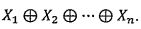
(a) (10%) Prove by induction that it represents an odd-parity function, that is, it evaluates to 1 if and only if the assignment to
variables X1,...,Xn contains an odd number of 1's. (For example, the assignment (X1, X2, X3, X4)= (1,0,0,0) contains one 1.)
 阿摩線上測驗
登入
阿摩線上測驗
登入