 阿摩線上測驗
題組內容
(6) (25%) Consider a discrete memoryless source (DMS) with the associated source alphabet X := {a, b, c, d, e,f, g}. Each source output is independenty selocted from C with the probability distribution Px given in Table 1. The goal of source coding for the DMS is to construct a code C that assigns cach symbol  bit string
 N. Its average length is defined as
 Moreover, the code is usually required to be uniquely decodable.
 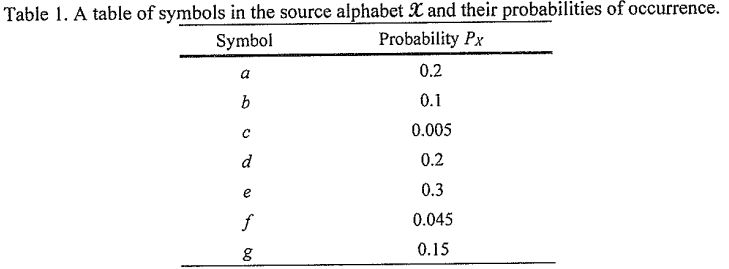 Please answer the following questions.
(b) (5%) A class of codes called the prefix-free codes can be decoded with no delay (hence sometimes also called instantareous codes). What is the definition for the prefix-free codes?
Every prefix-free code for the alphabet 9X with its codeword lengths 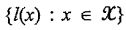 must satisfy the Kraftinequality. What is the Kraft inequality?
Assume that a code with its codeword lengths satisfies the Kraft inequality. Is it uniquely decodable? Does a uniquely decodable code have to satisfy the Kraft inequality?