阿摩線上測驗
登入
首頁
>
學士後西醫-有機化學
> 100年 - 100 學士後西醫:有機化學#35480
100年 - 100 學士後西醫:有機化學#35480
科目:
學士後西醫-有機化學 |
年份:
100年 |
選擇題數:
80 |
申論題數:
0
試卷資訊
所屬科目:
學士後西醫-有機化學
選擇題 (80)
1. Which of the following amines gives the correct order of base strengths? (A) aliphatic > ammonia > aromatic (B) aliphatic > aromatic > ammonia (C) aromatic > aliphatic > ammonia (D) aromatic > ammonia > aliphatic (E) ammonia > aromatic > aliphatic
2. The structural formula for vitamin C is shown below, identified by H which is most acidic?
(A) 1 (B) 2 (C) 3 (D) 4 (E) 5
3. What term describes the structural relationship between (2R,3R,4S)-2,3,4-trichloroheptane and (2R,3R,4R)-2,3,4-trichloroheptane? (A) not isomers (B) constitutional isomers (C) enantiomers (D) diastereomers (E) conformers
4. Rank the following sets of substituents in order of Cahn-Ingold-Prelog priorities from highest to lowest. Please pick the wrong order set. (A) -Cl, -S, -P, -H (B) -Br, -OH, -CH
3
, -H (C) -CO
2
H, CH
2
OH, -CH
2
NH
2
, -CN (D) -CH
2
OH, -CH=CH
2
, -CH
2
CH
3
, -CH
3
(E) -CH
2
OCH
3
, -CN, -C≡CH, -CH
2
CH
3
5. Which of the following pair of structures represent the different enantiomers?
6. Which of the following structure does not represent meso compounds?
(A) I (B) II (C) III (D) IV (E) V
7. Which of the statements below correctly describes an achiral molecule? (A) the molecule has a nonsuperimposable mirror image (B) the molecule exhibits optical activity when it interacts with plane-polarized light (C) the molecule has an enantiomer (D) the molecule might be a meso form (E) none of the above
8. Name these groups (left to right)
(A) sec-propyl, sec-butyl, isobutyl (B) isopropyl, isobutyl, sec-butyl (C) sec-propyl, tert-butyl, isobutyl (D) isopropyl, tert-butyl, isobutyl (E) isopropyl, tert-butyl, sec-butyl
9. What compound is formed when 2,2-dimethyloxirane is treated with ethanol containing a trace of HCl? (A) 2-ethoxy-2-methyl-1-propanol (B) 1-ethoxy-2-methyl-2-propanol (C) 2-ethoxy-2-methyl-2-propanol (D) 2-ethoxy-1-butanol (E) 1-ethoxy-2-butanol
10. Which of the following compounds gives a 1 H-NMR spectrum consisting of only two singlets? (A) CH
3
OCH
2
CH
2
OCH
2
CH
3
(B) CH
3
OCH
2
CH
2
CH
2
CH
2
OH (C) CH
3
OC(CH
3
)
2
OCH
3
(D) CH
3
OCH
2
CH(CH
3
)OCH
3
(E) CH
3
CH
2
OCH
2
CH
3
11. How many peaks appear in the proton spin decoupled 13C-NMR spectrum of the compound below?
(A) 1 (B) 2 (C) 3 (D) 4 (E) 5
12. Consider the branched hydrocarbon to the right. Which of the following would not be a prominent peak in the mass spectrum of this compound?
(A) m/z = 43 (B) m/z = 57 (C) m/z = 99 (D) m/z = 113 (E) m/z = 43 and m/z = 99
13. The correct order of increasing IR stretching frequencies for the following bonds.
(A) IV, I, V, II, III (B) IV, III, I, V, II (C) I, IV, II, V, III (D) IV, I, II, III, V (E) I, IV, III, II, V
14. Which of the following molecules is aromatic?
(A) 2 (B) 2 and 5 (C) 3 and 4 (D) 4 (E) 1 and 4
15. The following reaction presents the first step in the biological degradation of lysine. Please indicate the role of NADPH and name this reaction.
(A) reducing agent, reductive amination (B) reducing agent, decarboxylation (C) hydrogenation agent, Lindlar’s reaction (D) oxidized agent, transamination (E) oxidized agent, aldol condensation
16. The exact mechanism of the following reaction is difficult to establish conclusively. However, based on subtracts characters, which of the following pathway probably occurs to give GPP?
(A) SN1-like (B) E2-like (C) E1cB-like (D) E1-like (E) none of the above
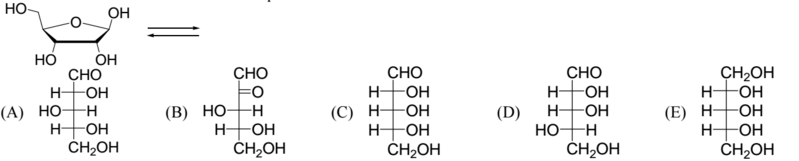
17. Which is the correct structure for the equilibrium below?
18. Assign E/Z nomenclature to the following alkene.
(A) (1Z, 3Z, 5Z, 7Z) (B) (1E, 3E, 5Z, 7Z) (C) (1E, 3E, 5E, 7Z) (D) (3E, 5Z) (E) (3Z, 5Z)
19. Which of the following is least likely to undergo a smooth crossed Claisen condensation with methyl pentanoate? (A) (CH
3
)
3
CCO
2
CH
3
(B) PhCH
2
CO
2
CH
3
(C) PhCO
2
CH
3
(D) HCO
2
CH
3
(E) (CH
3
O)
2
CO
20. Which of the following pairs of compounds would be the most reasonable choice for an attempt at a "mixed" or "crossed" aldol condensation?(A)
(B)
(C)
(D)
(E)
21. Which is the only one of these compounds which cannot self-condense in the presence of dilute aqueous alkali? (A) phenylethanal (B) propanal (C) 2,2-dimethylpropanal (D) 2-methylpropanal (E) 3-methylpentanal
22. Which of the following compounds would be the major product from aldol condensation of 6-oxoheptanal?
23. Which of the following Wittig reagents would be useful for converting R2C=O into R2CHCHO after hydrolysis? (A) Ph
3
P=CHOCH
3
(B) Ph
3
P=CHCH
3
(C) Ph
3
P=Cl
2
(D) Ph
3
P=CHCH=CH
2
(E) Ph
3
P=C(OCH
3
)
2
24. Reaction of ethylmagnesium bromide with which of the following compounds yields a tertiary alcohol after quenching with aqueous acid? (A) H
2
CO (B) CH
3
CHO (C) (CH
3
)
2
CO (D) ethylene oxide (E) n-butyllithium
25. What starting materials would be suitable for preparing this compound by a combination of Michael and aldol reactions?
(A) 4-methyl-2-cyclohexen-1-one and 3-butenal (B) 2-methylcyclohexane-1,3-dione and 3-buten-2-one (C) 2-methyl-2-vinyl-3-cyclohexen-1-one and acetaldehyde (D) 2-methyl-2-cyclohexen-1-one and 1,4-dichlorobutan-2-one (E) 4-methylcyclohexnone and methyl vinyl ketone
26. The ozonolysis of limonene give compound A plus formaldehyde. Choose the correct structure for A
27. Choose the endo product for the following reaction:
28. Rank the following compounds in order of increasing reactivity towards chlorination with Cl2/AlCl3 (slowest reacting to fastest).
29. What compound is produced when (R)-pentan-2-ol is treated with TsCl followed by NaI? (A) sodium (R)-pent-3-oxide (B) sodium (S)-pent-2-oxide (C) (R)-2-iodopentane (D) (S)-2-iodopentane (E) none of the above
30. What type of intermediate is present in the SN2 reaction of cyanide with bromoethane? (A) carbocation (B) free radical (C) carbene (D) carbanion (E) This reaction has no intermediate
31. The reaction reactivity was studied in different solvent. Please indicate the best solvent for the following reaction to offer the highest reactivity.
(A) hexane (B) chloroform (C) ethanol (D) water (E) no difference
32. Predict the major product for the following reaction. O NaOEt EtOH ?
(A)
(B)
(C)
(D)
(E) none of the above
33. How many sp
3
- and sp
2
-hybridized carbons does the following compound have?
(A) 6 and 7 (B) 7 and 6 (C) 8 and 4 (D) 4 and 8 (E) none
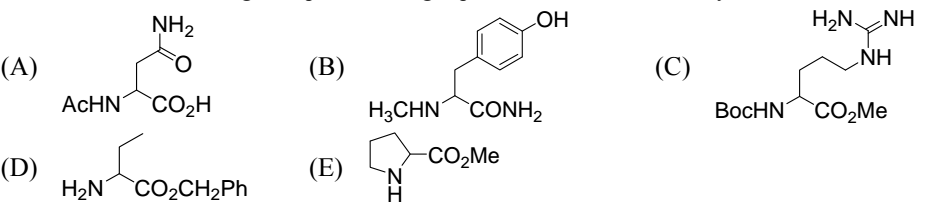
34. Ninhydrin can rapid react with a certain type of functional group to produce an intense purple color (positive result). Which of the following compound can get positive result after ninhydrin test?
35. When 2-methylcyclohexanone is treated with catalytic base in excess D
2
O, how many deuterium atoms become incorporated in the organic compound? (A) 0 (B) 1 (C) 2 (D) 3 (E) 5
36. Choose the structure that is not an intermediate or product of the following reaction.
37. Which of the following are intermediates in the acid hydrolysis of an amide?
(A) 4 (B) 1, 2 and 3 (C) 1 (D) 2 (E) 2 and 3
38. LiAl [OC(CH
3
)
3
]
3
H will reduce an acid chloride to an: (A) alcohol (B) alkane (C) acid (D) aldehyde (E) acetal
39. Rank the following from highest to lowest reactivity toward reaction with EtOH.
(A) A > C > E > D > B (B) C > A > E > D > B (C) E > C > A > D > B (D) C > A > B > E > D (E) C > A > D > B > E
40. In the mechanism for the dehydrohalogenation of 3-chloro-3,7-dimethyloctane, what is the dihedral angle between the hydrogen and chlorine atoms that are eliminated? (A) 0 degree (B) 45 degrees (C) 90 degrees (D) 135 degrees (E) 180 degrees
41. Which reagent is used to accelerate coupling reactions in both laboratory peptide synthesis and laboratory DNA synthesis? (A) catalytic H (B) dicyclohexylcarbodiimide (C) sodium hydroxide (D) ethyl chloroformate (E) PhS
-
NH4
+
42. What reagent is used to convert pentanamide to 1-pentanamine? (A) POCl
3
(B) CuCN (C) MeMgBr (D) SOCl
2
(E) LiAlH
4
43. Which of the following reactions will not yield a ketone product?
44. Which of the following is a nonreducing sugar (does not react with Tollens' reagent)?
45. Formulas for four ethyl ethers are drawn below.Which two ethers are cleaved by aqueous acid much more easily than the other two?
(A) I and II (B) II and III (C) III and IV (D) I and IV (E) III and IV
46. The formula of brevicomin, a pheremone of the western pine beetle, is shown below. What open chain ketodiol would close to this bicyclic acetal? (ignore stereoisomer issues)
(A) 7,8-dihydroxynonan-3-one (B) 6,7-dihydroxynonan-3-one (C) 7,8-dihydroxynonan-2-one (D) 6,7-dihydroxynonan-2-one (E) 6,7-dihydroxynonan-4-one
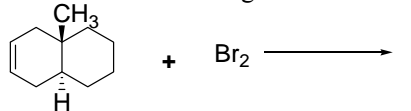
47. Which of the following will be the kinetically favored product from the depicted reaction ?
48. Which of the following alcohols undergoes dehydration upon heating with concentrated H
2
SO
4
without carbocation rearrangement? (A) 2-methylhexan-3-ol (B) 3-methylpentan-3-ol (C) 3,3-dimethylpentan-2-ol (D) 2-methyl-2-phenylpropan-1-ol (E) both A and B
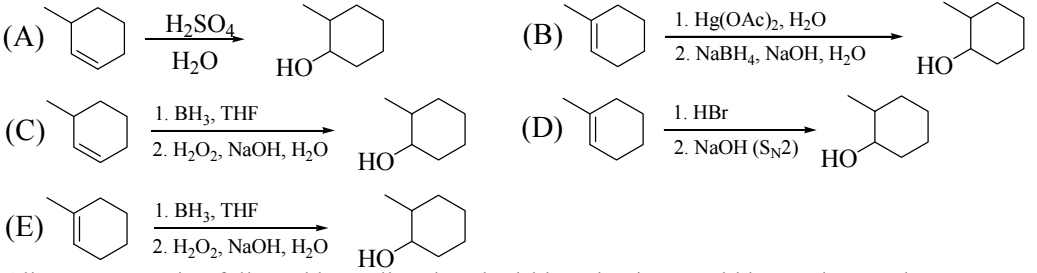
49. Choose the reaction, or reaction sequence, that best accomplishes the preparation of 2-methylcyclohexanol.
50. Alkoxymercuration followed by sodium borohydride reduction would be used to produce (A) alcohol from an alkene (B) aldehyde from alcohol (C) acid from an alkyne (D) ether from an alkene (E) alkene from an aryl halide
51. What is the structure for A?
52. Which reagent(s) can be used to convert bromobenzene to benzoic acid? (A) 1. NaCN; 2. NaOH, H
2
O (B) KMnO
4
(C) 1. Mg; 2. CO
2
, then H
3
O
+
(D) CrO
3
, HCl (E) 1. CH
3
Br; 2. CrO
3
, H
2
SO
4
.
53. In addition to 2-butanone, a second product is formed in the following acid-base reaction. Choose the structure for this second product.
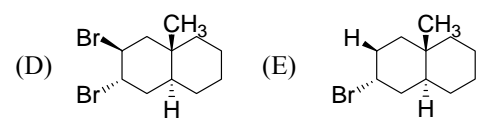
54. Which of the base(s) below that cannot be used in the following reaction.
(A) EtONa (B) NaH (C) BuLi (D) NaNH
2
(E) CH
3
MgBr
55. What is the major organic product that results when 1-heptyne is treated with 2 equivalents of HBr? (A) 2,3-dibromo-1-heptene (B) 2,3-dibromo-2-heptene (C) 1,2-dibromoheptane (D) 2,2-dibromoheptane (E) 1,1-dibromoheptane
56. Which of the following would represent the correct reaction conditions for the following conversion?
(A) 1. NaOH, H
2
O; 2. LiAlH
4
(B) 1. Mg, ether; 2. CO
2
; 3. LiAlH
4
(C) 1. KMnO
4
; 2. LiAlH
4
(D) 1. SOCl
2
, benzene; 2. LiAlH
4
(E) 1. LiAlH
4
, H
2
O; 2. NaOH, 3-methyl-2-propylpyridine
57. Which reagent would best serve as the basis for a simple chemical test to distinguish the two compounds below
(A) NaOI (I
2
in NaOH) (B) Br
2
in CCl
4
(C) CrO
3
in H
2
SO
4
(D) NaHCO
3
in H
2
O (E) Ag(NH
3
)2OH
58. Which of the following is a suitable method for synthesizing only methyl vinyl ketone (CH
3
COCH=CH
2
)?
59. Which of the following acids does not decarboxylate on heating?
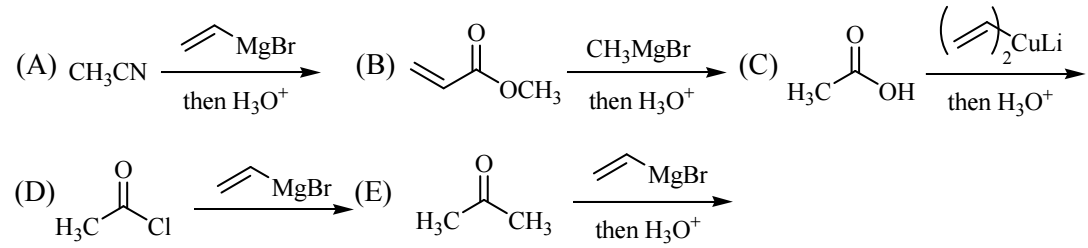
60. Which of the following schemes will proceed to give the compound indicated as the major product.
(A) I only (B) I and II (C) II and III (D) I and III (E) all of them
61. Which of the following statement for Diels-Alder reaction is false? (A) Diels-Alder reaction is a pericyclic process. (B) The endo product, rather than exo product, is formed. (C) It is a thermal reaction. (D) It is a suprafacial [4+2]-π-electron cycloaddition. (E) None of the above.
62. Choose the incorrect statement about the following acid/base reactions involving propyne and its anion propynide. (pKa : H
2
O = 16; CH
3
C≣CH = 25; NH
3
= 34)
(A) The equilibrium in (i) lies to the left. (B) The equilibrium in (ii) lies to the right. (C) You can prepare propynide salts in NH3 (D) In reaction (ii) ammonia, NH3, acts as a base. (E) Propyne is a stronger acid than ammonia
63. Which of the following compound does not contain carbonyl group(s) in its structure? (A) dicyclohexylcarbodiimide (B) cycloheptatrienone (C) sulfanilamide (D) benzoyl phosphate (E) dimethyl malonate
64. Which comopund has the smallest heat of hydrogenation? (A) 5-methyl-1,2-hexadiene (B) (E)-5-methyl-1,3-hexadiene (C) 5-methyl-1,4-hexadiene (D) 2-methyl-1,5-hexadiene (E) (E)-2-methyl-2,4-hexadiene
65. The correct priority of functional groups in IUPAC nomenclature is: (A) acid > ester > amide > ketone (B) amide > acid > ester > ketone (C) amide > ester > acid > ketone (D) ester > amide > ketone > acid (E) ketone > acid > ester > amide
66. Structure I-IV may represent a conformation of 2,2-difluorobutane sighting along any C-C bond. Please pick up right structures.
(A) I, II, III (B) II, III, IV (C) I, II, IV (D) all of the above (E) none of the above
67. Which of the following reactions of alkenes is not stereospecific? (A) bromohydrin formation (Br
2
in H2O) (B) hydrogenation (H
2
, Pd) (C) bromination (Br
2
) (D) acid-catalyzed hydration (H
2
O, H
2
SO
4
) (E) dihydroxylation (OsO
4
, NaHSO
3
)
68. Which system would give the largest ratio of substitution to elimination product(s)? (A) cyclohexanol + acid (B) cyclohexyl iodide + t-BuOK in t-BuOH (C) 1-bromobutane + t-BuOK in DMSO (D) 1-bromobutane + KI in acetone (E) 2-bromobutane + MeONa in DMSO
69. Optically pure (S)-monosodium glutamate has a specific rotation of +25o , what percent of (R)-monosodium glutamate in a sample with a specific rotation of -10o ? (A) 10% (B) 30% (C) 40% (D) 70% (E) 50%
70. What reagents can be used to convert 1-hexyne into 2-hexanone? (A) 1. Sia
2
BH; 2. H
2
O
2
, NaOH (B) Hg
2+
, H
2
SO
4
, H
2
O (C) 1. O
3
; 2. (CH
3
)
2
S (D) 1. CH
3
MgBr; 2. CO
2
(E) 1. H
2
, Ni; 2. Na
2
Cr
2
O
7
, H
2
SO
4
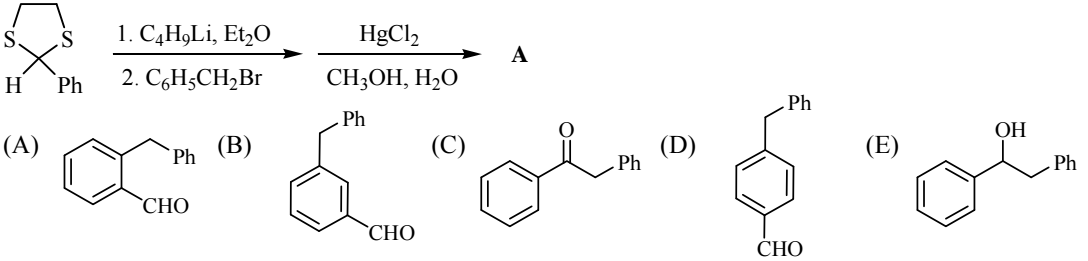
71. Below is a propose a synthesis of compound A. Which step would not work.
72. The syntheses shown here are unlikely to occur as written. What is wrong with each?
73. Which of the reactions below would not produce n-butylamine ?
74. Determine the product of the synthetic sequence below.
75. A chiral C
7
H
16
O
2
diol is oxidized by PCC in CH
2
Cl
2
to an achiral C
7
H
12
O
2
compound. Which of the following would satisfy these facts?
76. Which of the following molecules is chiral?
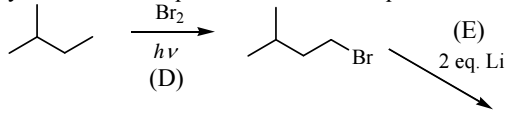
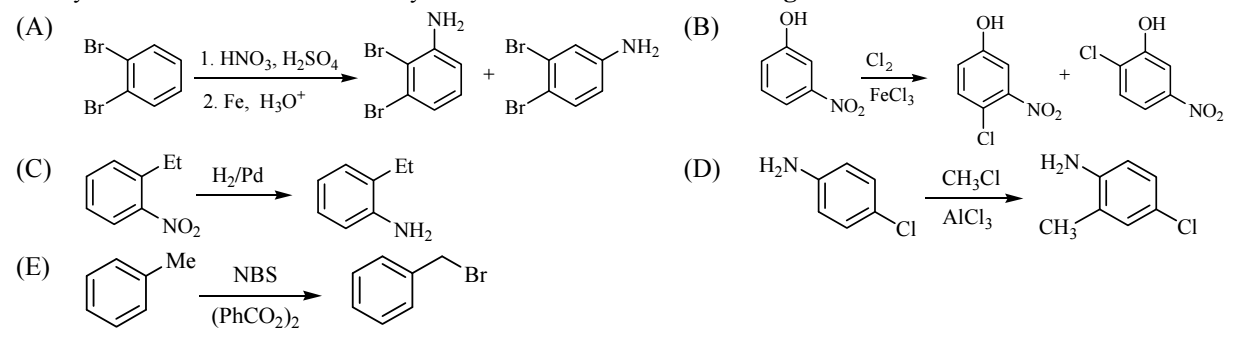
77. Stereoisomers I and II undergo E2 elimination on treatment with sodium ethoxide in ethanol. One isomer reacts 500 times faster than the other. Also, one isomer gives X as the only product, whereas the other gives Y together with some X. Which of the following statements provides the best assignment of I and II?
(A) II reacts faster and gives both Y and X (B) II reacts faster and gives only X (C) I reacts faster and gives both Y and X (D) I reacts faster and gives only Y (E) I reacts faster and gives only X
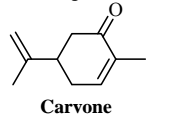
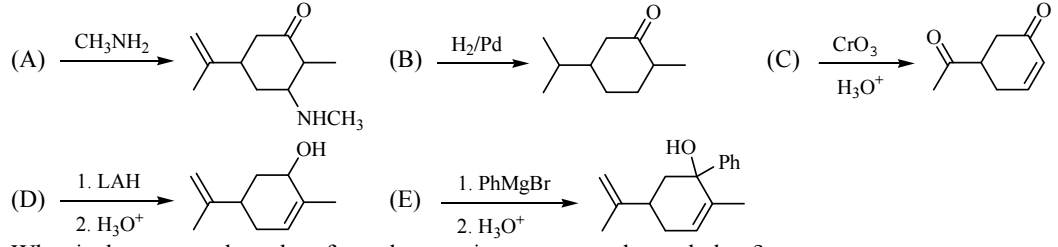
78. What product is wrong when carvone is treated with the following reagents?
79. What is the expected product from the reaction sequence drawn below?
80. Only one of the following amines will lose its nitrogen atom as trimethyl amine by repeated Hofmann elimination reactions (exhaustive methylation followed by heating with AgOH). Identify that amine.
申論題 (0)
相關試卷
105年 - 105 學士後西醫:有機化學#78642
105年 · #78642
104年 - 104 學士後西醫:有機化學#27032
104年 · #27032
103年 - 103 學士後西醫:有機化學#27037
103年 · #27037
102年 - 102 學士後西醫:有機化學#27324
102年 · #27324
101年 - 101 學士後西醫:有機化學#27197
101年 · #27197
98年 - 098 學士後西醫:有機化學#37156
98年 · #37156
96年 - 96學士後西醫-有機化學 #37201
96年 · #37201
 阿摩線上測驗
登入
阿摩線上測驗
登入
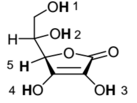 (A) 1 (B) 2 (C) 3 (D) 4 (E) 5

 (A) I (B) II (C) III (D) IV (E) V
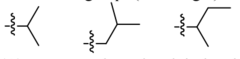 (A) sec-propyl, sec-butyl, isobutyl (B) isopropyl, isobutyl, sec-butyl (C) sec-propyl, tert-butyl, isobutyl
(D) isopropyl, tert-butyl, isobutyl (E) isopropyl, tert-butyl, sec-butyl
(A) sec-propyl, sec-butyl, isobutyl (B) isopropyl, isobutyl, sec-butyl (C) sec-propyl, tert-butyl, isobutyl
(D) isopropyl, tert-butyl, isobutyl (E) isopropyl, tert-butyl, sec-butyl
 (A) 1 (B) 2 (C) 3 (D) 4 (E) 5
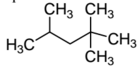 (A) m/z = 43 (B) m/z = 57 (C) m/z = 99 (D) m/z = 113 (E) m/z = 43 and m/z = 99
 (A) IV, I, V, II, III (B) IV, III, I, V, II (C) I, IV, II, V, III (D) IV, I, II, III, V (E) I, IV, III, II, V
 (A) 2 (B) 2 and 5 (C) 3 and 4 (D) 4 (E) 1 and 4
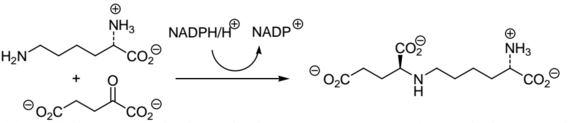 (A) reducing agent, reductive amination (B) reducing agent, decarboxylation
(C) hydrogenation agent, Lindlar’s reaction (D) oxidized agent, transamination
(E) oxidized agent, aldol condensation
(A) reducing agent, reductive amination (B) reducing agent, decarboxylation
(C) hydrogenation agent, Lindlar’s reaction (D) oxidized agent, transamination
(E) oxidized agent, aldol condensation
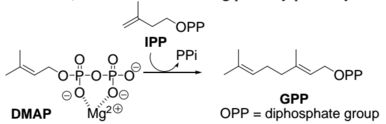 (A) SN1-like (B) E2-like (C) E1cB-like (D) E1-like (E) none of the above
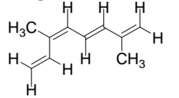 (A) (1Z, 3Z, 5Z, 7Z) (B) (1E, 3E, 5Z, 7Z) (C) (1E, 3E, 5E, 7Z) (D) (3E, 5Z) (E) (3Z, 5Z)
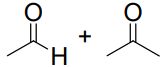 (B)
(B)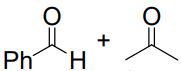 (C)
(C)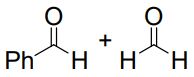 (D)
(D)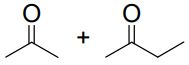 (E)
(E)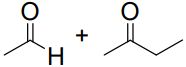

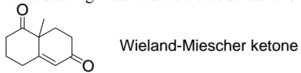 (A) 4-methyl-2-cyclohexen-1-one and 3-butenal (B) 2-methylcyclohexane-1,3-dione and 3-buten-2-one
(C) 2-methyl-2-vinyl-3-cyclohexen-1-one and acetaldehyde (D) 2-methyl-2-cyclohexen-1-one and 1,4-dichlorobutan-2-one
(E) 4-methylcyclohexnone and methyl vinyl ketone
(A) 4-methyl-2-cyclohexen-1-one and 3-butenal (B) 2-methylcyclohexane-1,3-dione and 3-buten-2-one
(C) 2-methyl-2-vinyl-3-cyclohexen-1-one and acetaldehyde (D) 2-methyl-2-cyclohexen-1-one and 1,4-dichlorobutan-2-one
(E) 4-methylcyclohexnone and methyl vinyl ketone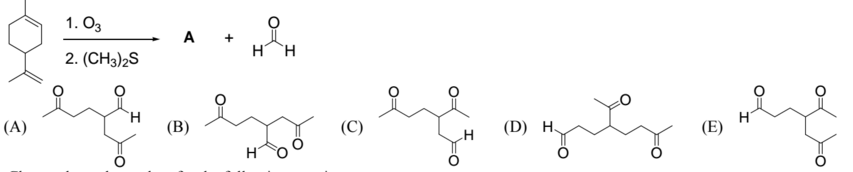


 (A) hexane (B) chloroform (C) ethanol (D) water (E) no difference
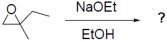 (A)
(A) (B)
(B) (C)
(C) (D)
(D) (E) none of the above
 (A) 6 and 7 (B) 7 and 6 (C) 8 and 4 (D) 4 and 8 (E) none
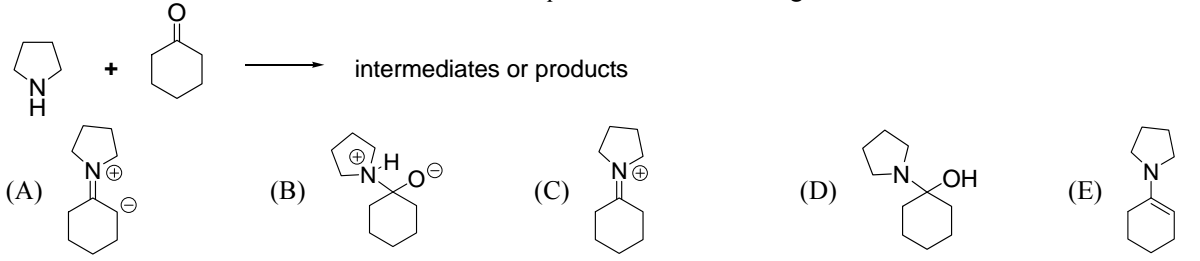
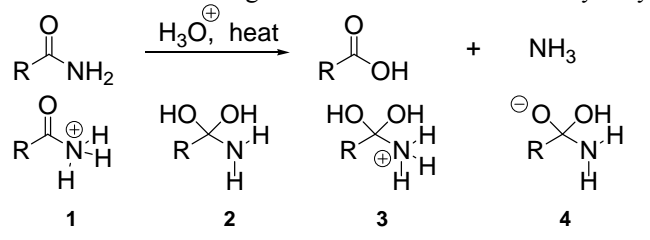 (A) 4 (B) 1, 2 and 3 (C) 1 (D) 2 (E) 2 and 3
 (A) A > C > E > D > B (B) C > A > E > D > B (C) E > C > A > D > B
(D) C > A > B > E > D (E) C > A > D > B > E
(A) A > C > E > D > B (B) C > A > E > D > B (C) E > C > A > D > B
(D) C > A > B > E > D (E) C > A > D > B > E

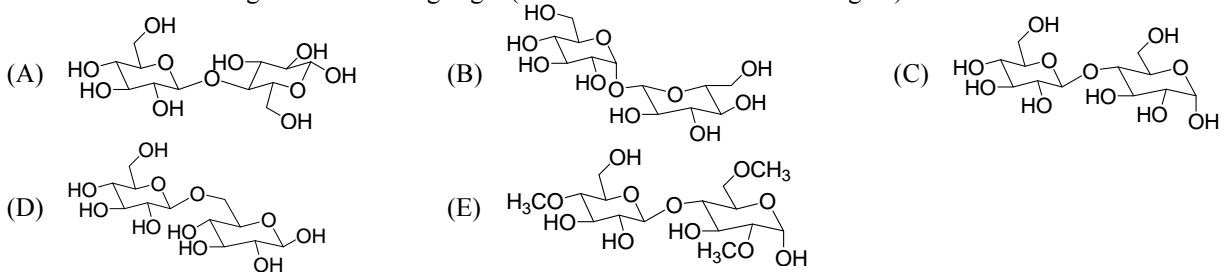
 (A) I and II (B) II and III (C) III and IV (D) I and IV (E) III and IV
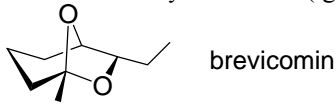 (A) 7,8-dihydroxynonan-3-one (B) 6,7-dihydroxynonan-3-one (C) 7,8-dihydroxynonan-2-one
(D) 6,7-dihydroxynonan-2-one (E) 6,7-dihydroxynonan-4-one
(A) 7,8-dihydroxynonan-3-one (B) 6,7-dihydroxynonan-3-one (C) 7,8-dihydroxynonan-2-one
(D) 6,7-dihydroxynonan-2-one (E) 6,7-dihydroxynonan-4-one


 (A) EtONa (B) NaH (C) BuLi (D) NaNH2 (E) CH3MgBr
 (A) 1. NaOH, H2O; 2. LiAlH4 (B) 1. Mg, ether; 2. CO2; 3. LiAlH4
(C) 1. KMnO4; 2. LiAlH4 (D) 1. SOCl2, benzene; 2. LiAlH4
(E) 1. LiAlH4, H2O; 2. NaOH, 3-methyl-2-propylpyridine
(A) 1. NaOH, H2O; 2. LiAlH4 (B) 1. Mg, ether; 2. CO2; 3. LiAlH4
(C) 1. KMnO4; 2. LiAlH4 (D) 1. SOCl2, benzene; 2. LiAlH4
(E) 1. LiAlH4, H2O; 2. NaOH, 3-methyl-2-propylpyridine
 (A) NaOI (I2 in NaOH) (B) Br2 in CCl4 (C) CrO3 in H2SO4
(D) NaHCO3 in H2O (E) Ag(NH3)2OH
(A) NaOI (I2 in NaOH) (B) Br2 in CCl4 (C) CrO3 in H2SO4
(D) NaHCO3 in H2O (E) Ag(NH3)2OH

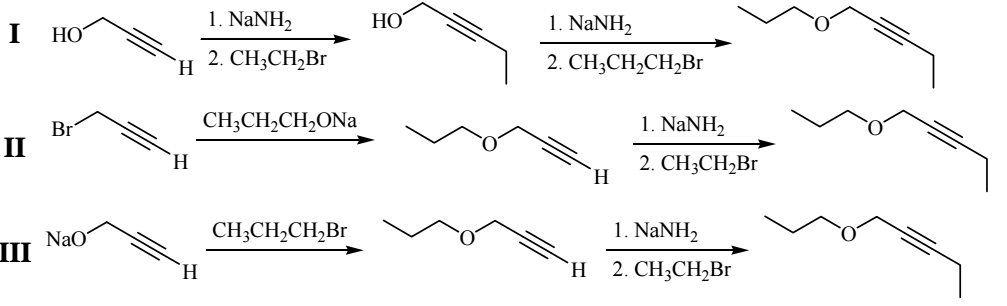 (A) I only (B) I and II (C) II and III (D) I and III (E) all of them
 (A) The equilibrium in (i) lies to the left. (B) The equilibrium in (ii) lies to the right.
(C) You can prepare propynide salts in NH3 (D) In reaction (ii) ammonia, NH3, acts as a base.
(E) Propyne is a stronger acid than ammonia
(A) The equilibrium in (i) lies to the left. (B) The equilibrium in (ii) lies to the right.
(C) You can prepare propynide salts in NH3 (D) In reaction (ii) ammonia, NH3, acts as a base.
(E) Propyne is a stronger acid than ammonia
 (A) I, II, III (B) II, III, IV (C) I, II, IV (D) all of the above (E) none of the above





 (A) II reacts faster and gives both Y and X (B) II reacts faster and gives only X
(C) I reacts faster and gives both Y and X (D) I reacts faster and gives only Y
(E) I reacts faster and gives only X
(A) II reacts faster and gives both Y and X (B) II reacts faster and gives only X
(C) I reacts faster and gives both Y and X (D) I reacts faster and gives only Y
(E) I reacts faster and gives only X