阿摩線上測驗
登入
首頁
>
學士後西醫-有機化學
>
100年 - 100 學士後西醫:有機化學#35480
> 試題詳解
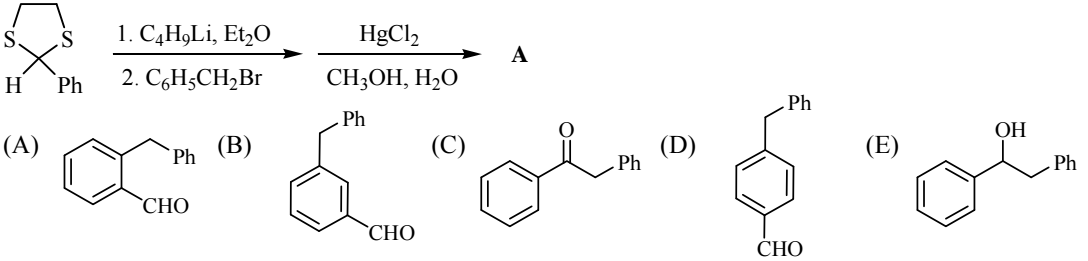
51. What is the structure for A?
答案:
登入後查看
統計:
A(0), B(0), C(15), D(5), E(0) #1026936
詳解 (共 1 筆)
大家加油! 邀請碼228480
B1 · 2025/12/10
#7222897
這是一個典型的1,3-二硫烷(Dith...
(共 2399 字,隱藏中)
前往觀看
0
1
相關試題
1. Which of the following amines gives the correct order of base strengths? (A) aliphatic > ammonia > aromatic (B) aliphatic > aromatic > ammonia (C) aromatic > aliphatic > ammonia (D) aromatic > ammonia > aliphatic (E) ammonia > aromatic > aliphatic
#1026886
2. The structural formula for vitamin C is shown below, identified by H which is most acidic? (A) 1 (B) 2 (C) 3 (D) 4 (E) 5
#1026887
3. What term describes the structural relationship between (2R,3R,4S)-2,3,4-trichloroheptane and (2R,3R,4R)-2,3,4-trichloroheptane? (A) not isomers (B) constitutional isomers (C) enantiomers (D) diastereomers (E) conformers
#1026888
4. Rank the following sets of substituents in order of Cahn-Ingold-Prelog priorities from highest to lowest. Please pick the wrong order set. (A) -Cl, -S, -P, -H (B) -Br, -OH, -CH3, -H (C) -CO2H, CH2OH, -CH2NH2, -CN (D) -CH2OH, -CH=CH2, -CH2CH3, -CH3 (E) -CH2OCH3, -CN, -C≡CH, -CH2CH3
#1026889
5. Which of the following pair of structures represent the different enantiomers?
#1026890
6. Which of the following structure does not represent meso compounds? (A) I (B) II (C) III (D) IV (E) V
#1026891
7. Which of the statements below correctly describes an achiral molecule? (A) the molecule has a nonsuperimposable mirror image (B) the molecule exhibits optical activity when it interacts with plane-polarized light (C) the molecule has an enantiomer (D) the molecule might be a meso form (E) none of the above
#1026892
8. Name these groups (left to right) (A) sec-propyl, sec-butyl, isobutyl (B) isopropyl, isobutyl, sec-butyl (C) sec-propyl, tert-butyl, isobutyl (D) isopropyl, tert-butyl, isobutyl (E) isopropyl, tert-butyl, sec-butyl
#1026893
9. What compound is formed when 2,2-dimethyloxirane is treated with ethanol containing a trace of HCl? (A) 2-ethoxy-2-methyl-1-propanol (B) 1-ethoxy-2-methyl-2-propanol (C) 2-ethoxy-2-methyl-2-propanol (D) 2-ethoxy-1-butanol (E) 1-ethoxy-2-butanol
#1026894
10. Which of the following compounds gives a 1 H-NMR spectrum consisting of only two singlets? (A) CH3OCH2CH2OCH2CH3 (B) CH3OCH2CH2CH2CH2OH (C) CH3OC(CH3)2OCH3 (D) CH3OCH2CH(CH3)OCH3 (E) CH3CH2OCH2CH3
#1026895
相關試卷
105年 - 105 學士後西醫:有機化學#78642
2016 年 · #78642
104年 - 104 學士後西醫:有機化學#27032
2015 年 · #27032
103年 - 103 學士後西醫:有機化學#27037
2014 年 · #27037
102年 - 102 學士後西醫:有機化學#27324
2013 年 · #27324
101年 - 101 學士後西醫:有機化學#27197
2012 年 · #27197
100年 - 100 學士後西醫:有機化學#35480
2011 年 · #35480
98年 - 098 學士後西醫:有機化學#37156
2009 年 · #37156
96年 - 96學士後西醫-有機化學 #37201
2007 年 · #37201
 阿摩線上測驗
登入
阿摩線上測驗
登入
阿摩線上測驗
登入
阿摩線上測驗
登入