阿摩線上測驗
登入
首頁
>
學士後西醫-有機化學
>
100年 - 100 學士後西醫:有機化學#35480
> 試題詳解
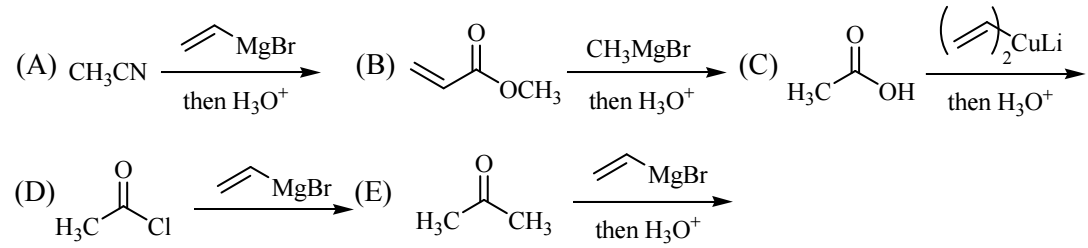
58. Which of the following is a suitable method for synthesizing only methyl vinyl ketone (CH
3
COCH=CH
2
)?
答案:
登入後查看
統計:
A(19), B(6), C(8), D(6), E(0) #1026943
詳解 (共 2 筆)
養樂多(MT112、後中上榜)
B1 · 2024/06/27
#6146023
(A)(B)(D)(E) Grignar...
(共 154 字,隱藏中)
前往觀看
10
0
大家加油! 邀請碼228480
B2 · 2025/12/10
#7223091
這個問題要求找到一種能夠選擇性地 (s...
(共 2976 字,隱藏中)
前往觀看
2
0
其他試題
54. Which of the base(s) below that cannot be used in the following reaction. (A) EtONa (B) NaH (C) BuLi (D) NaNH2 (E) CH3MgBr
#1026939
55. What is the major organic product that results when 1-heptyne is treated with 2 equivalents of HBr? (A) 2,3-dibromo-1-heptene (B) 2,3-dibromo-2-heptene (C) 1,2-dibromoheptane (D) 2,2-dibromoheptane (E) 1,1-dibromoheptane
#1026940
56. Which of the following would represent the correct reaction conditions for the following conversion? (A) 1. NaOH, H2O; 2. LiAlH4 (B) 1. Mg, ether; 2. CO2; 3. LiAlH4 (C) 1. KMnO4; 2. LiAlH4 (D) 1. SOCl2, benzene; 2. LiAlH4 (E) 1. LiAlH4, H2O; 2. NaOH, 3-methyl-2-propylpyridine
#1026941
57. Which reagent would best serve as the basis for a simple chemical test to distinguish the two compounds below (A) NaOI (I2 in NaOH) (B) Br2 in CCl4 (C) CrO3 in H2SO4 (D) NaHCO3 in H2O (E) Ag(NH3)2OH
#1026942
59. Which of the following acids does not decarboxylate on heating?
#1026944
60. Which of the following schemes will proceed to give the compound indicated as the major product. (A) I only (B) I and II (C) II and III (D) I and III (E) all of them
#1026945
61. Which of the following statement for Diels-Alder reaction is false? (A) Diels-Alder reaction is a pericyclic process. (B) The endo product, rather than exo product, is formed. (C) It is a thermal reaction. (D) It is a suprafacial [4+2]-π-electron cycloaddition. (E) None of the above.
#1026946
62. Choose the incorrect statement about the following acid/base reactions involving propyne and its anion propynide. (pKa : H2O = 16; CH3C≣CH = 25; NH3 = 34) (A) The equilibrium in (i) lies to the left. (B) The equilibrium in (ii) lies to the right. (C) You can prepare propynide salts in NH3 (D) In reaction (ii) ammonia, NH3, acts as a base. (E) Propyne is a stronger acid than ammonia
#1026947
63. Which of the following compound does not contain carbonyl group(s) in its structure? (A) dicyclohexylcarbodiimide (B) cycloheptatrienone (C) sulfanilamide (D) benzoyl phosphate (E) dimethyl malonate
#1026948
64. Which comopund has the smallest heat of hydrogenation? (A) 5-methyl-1,2-hexadiene (B) (E)-5-methyl-1,3-hexadiene (C) 5-methyl-1,4-hexadiene (D) 2-methyl-1,5-hexadiene (E) (E)-2-methyl-2,4-hexadiene
#1026949