所屬科目:研究所、轉學考(插大)◆普通植物學
1. The water movement is from high water potential to low water potential. So the water movement is a/an _____.(A) active transport (B) active and passive transport (C) passive transport (D) water can't move.
2. Which statement is WRONG? (A) When you observe a symptom in the older leaves of a plant, the plant likely needs certain immobile nutrients. (B) Plants will not complete their life cycle without any essential elements. (C) Due to the cation exchange process, the soil in an area with low pH and lots of rain will lack minerals. (D) Anions (ions with negative charges) easily be washed away by the rain.
3. Leaf senescence and abscission are regulated by _____.(A) ABA and JA (B) ABA and Auxin (C) Auxin and CKs (D) Auxin and ethylene
4. About the biological nitrogen fixation, which statement is CORRECT? (A) All nitrogen-fixation bacteria require plants as hosts. (B) Some simple eukaryotes also can perform nitrogen fixation. (C) Since the process of nitrogen fixation requires a lot of ATP, high [O2] is necessary for the reaction. (D) The key enzyme for nitrogen fixation is nitrogenase.
5. What enzyme catalyzes the first CO2 fixation in C4 and CAM plants? (A) Rubisco. (B) PEP carboxylase. (C) Reductase (D) -ATPase
6. What are the final products of light reactions? (A) H+ and CO2 (B) and ADP (C) NADPH and ATP (D) Fd and electrons
7. Which lists tissues or structures in the order of haploid, diploid, triploid? (A) Petal, pollen, endosperm (B) Petal, endosperm, pollen (C) Pollen, petal, endosperm (D) Pollen, endosperm, petal
8. Which statement about water movement in a plant is WRONG? (A) The growing root tips are the major sites for water uptake. (B) The water movement is influenced by the solute concentration. (C) Water can diffuse directly through the membrane, so there is no membrane protein for water uptake. (D) Water uptake by a cell will generate turgor.
9. What is TRUE about the xylem transport and phloem translocation? (A) Both are driven by a pressure gradient. (B) Both are driven by negative pressure. (C) Only xylem transport involves water movement. (D) Both movements are bidirectional.
10. Which description of sexual and asexual reproduction is WRONG? (A) The progeny of asexual reproduction has less genetic variation and has an advantage in a stable environment. (B) Sexual reproduction always has more offspring. (C) Asexual reproduction is suitable for keeping beautiful orchid flower species. (D) Sexual reproduction may need the help of animals.
11. Phloem transport of sucrose is often described as going from source to sink. Which of the following is most likely to function as a source? (A) a growing leaf in early spring (B) a growing root in late summer (C) a tuber in early spring (D) a shoot tip in late fall
12. Which description of the signal transduction pathway is WRONG? (A) Generally, there are three steps: reception, transduction, and response. (B) The receptors responsible for the reception are always membrane proteins. (C) The second messengers are used in the transduction step. (D) In most cases, the responses involve changing cellular activities.
13. Which of the following statements about algal blooms is WRONG? (A) They are associated with water disturbed by humans. (B) They are often correlated with the release of toxic compounds. (C) Some are known as red or brown tides. (D) The frequency of marine algal blooms has decreased globally.
14. The heterocysts of cyanobacteria are most closely associated with: (A) Sporulation. (B) Nitrogen fixation. (C) Photosynthesis. (D) Buoyancy.
15. Which of the following statements about lichens is WRONG? (A) They consist of a mycobiont and a photobiont. (B) They are very resistant to pollutants. (C) They live in the harshest environments. (D) They reproduce asexually by forming fragments, soredia, or isidia.
16. In fungi, what is the structure called when two haploid nuclei do not fuse? (A) Gametangium. (B) Sporangium. (C) Conidiogenous cell. (D) Dikaryon.
17. The cell walls of fungi are composed of (A) Cellulose. (B) Glycogen. (C) Pectin. (D) Chitin.
18. Which of the following statements about bryophytes is WRONG? (A) Lack xylem and phloem. (B) Cell walls of their water-conducting cells are suberized. (C) Exhibit alternating heteromorphic generations. (D) Sporophyte is nutritionally dependent on gametophyte.
19. Microphylls differ from megaphylls in that microphylls: (A) They occur in most vascular plants. (B) They are associated with leaf gaps. (C) They are associated with protosteles. (D) They have branched veins.
20. Heterospory differs from homospory in that heterospory involves: (A) Gametophytes with endosporic development. (B) Larger gametophytes. (C) Bisexual gametophytes. (D) Spores differentiated on the basis of size not function.
21. Which of the following statements about angiosperms is WRONG? (A) The three-celled male gametophyte. (B) The triploid endosperm. (C) An archegonium within the female gametophyte. (D) Ovules are housed within ovaries.
22. Which of the following statements about the zygomorphic flower is FALSE? (A) Bilaterally symmetrical flowers. (B) Irregular flowers. (C) It is a basal character of angiosperms. (D) Likely to be visited by specialized pollinators.
23. Water moving from the cytosol of a cortical cell directly into the cytosol of an adjacent cortical cell via plasmodesmata follows the: (A) Symplastic pathway only. (B) Apoplastic pathway only. (C) Transcellular pathway only. (D) Apoplastic and transcellular pathways.
24. Which of the following statements about sclerenchyma is WRONG? (A) The major supporting tissue. (B) Usually dead at maturity. (C) The presence of lignin makes the cell wall of sclerenchyma rigid. (D) It contains the secondary wall but without the primary wall.
25. What are the key innovations for survival when plants moved from water onto land EXCEPT: (A) The formation of stomata. (B) The formation of vascular tissues. (C) The formation of central vacuole. (D) The formation of secondary wall.
26. Which of the following statements about the apical meristem is WRONG? (A) The mother of all cells in plants that gives rise to all cells, tissues and organs. (B) It produces cells that increase in diameter and to a lesser extent in length. (C) A group of unspecialized, dividing cells. (D) By cell division in the apical meristem, plants can grow closer or away from a stimulus.
27. In the primary growth, all of the following meristems occur EXCEPT: (A) Protoderm. (B) Ground meristem. (C) Procambium. (D) Vascular cambium.
28. What is the volume of the rhizosphere? (A) Nitrogen-fixing bacteria surrounding the root. (B) Soil around the root. (C) Mucilage secreted by the root. (D) Root hairs plus mucilage.
29. In most monocots, the base of the leaf is expanded into a _____. (A) Blade. (B) Stipule. (C) Sheath. (D) Petiole.
30. In plant disease defense response, what is the receptor which specifically recognizes the pathogen? (A) a resistance protein. (B) a virulent protein. (C) an avirulent protein. (D) an effector protein.
1. Consider a tree that is 50 m tall and transpires roughly 90 liters of water daily. How many calories will the tree use to transpire this quantity of water?
(1) A: 10% NaCl; B: pure water
(2) A: 10% sucrose solution; B: 50% sucrose solution
(3) A: solute potential = -0.8, pressure potential = 2; B: solute potential = -0.1, pressure potential = 0.5
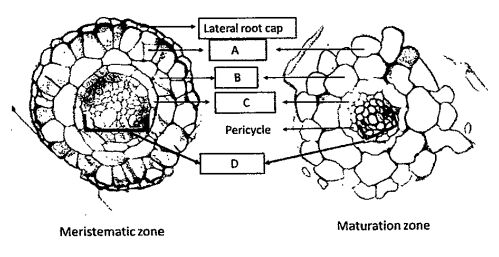
3. The following figure contains two cross-sections of a dicot root. Label the correct names of A to D.
4. What are the differences between a gametophyte and a sporophyte? Which one is more dominant in nonvascular plants like mosses and vascular plants like ferns?
5. Describe and compare the nutrients gain of autotrophs and heterotrophs.
6. Describe and compare the features that distinguish mesophytes, xerophytes, and hydrophytes.
 阿摩線上測驗
登入
阿摩線上測驗
登入
 -ATPase
 and ADP (C) NADPH and ATP (D) Fd and electrons