所屬科目:研究所、轉學考(插大)◆無機化學
1. Which breakthrough was awarded the Nobel Prize in Chemistry in 2023?(A)Development of ultra-high-resolution electron microscopy for biological systems(B)Discovery and synthesis of quantum dots(C)Discovery of a new class of antibiotics targeting antibiotic-resistant bacteria(D)Advancements in computational chemistry for drug discovery(E)Creation of sustainable and efficient hydrogen production methods
2. Give the number of geometric isomers for an octahedral compound MA₂B₂C₂. (Note: A, B, and C are monodentate ligands)(A)1(B)2(C)3(D)4(E)5
3. Which of the following transition metals is a component of vitamin B₁₂?(A)Co(B)Zn(C)Fe(D)Au(E)Cu
4. The unit cell in a certain lattice consists of a cube formed by an anion at each corner, an anion in the center, and a cation at the center of each face. How many cations and anions does the unit cell contain?(A)3, 2(B)2, 2(C)3, 5(D)3, 4(E)6, 5
5. For the following reaction, what would be the ratio of cis to trans isomers in the product?[Co(NH₃)₅Cl]²⁺ + Cl⁻ → [Co(NH₃)₄Cl₂]⁺ + NH₃(A)1:1(B)2:1(C)1:2(D)4:1(E)1:4
6. The following graph shows the radial distribution functions of 6s, 4f, 5d, and 6p of an H atom. Which one is 4f?(A)A(B)B(C)C(D)D
7. Below is the molecular structure of an efficient catalyst for the deconstruction of polyethylene (PE), what is the oxidation state of Ir?(A)0(B)+1(C)+2(D)+3(E)+5
8. Following Question 7, what is the electron count of this complex?(A)14(B)16(C)17(D)18(E)20
9. The following are the molecular orbitals of O₂. Which one represents the π* orbital?(A)A(B)B(C)C(D)D(E)E
10. Which property distinguishes inorganic nanoparticles from their bulk counterparts?(A)Increased solubility in polar solvents(B)Reduced surface area to volume ratio(C)Enhanced reactivity due to decreased surface area(D)Altered optical, electronic, or magnetic properties at the nanoscale(E)Lower sensitivity to environmental factors compared to bulk materials
11. SF₆ has A₁g, Eg, and T₁u vibrational modes. The T₁u mode is(A)IR and Raman active(B)IR and Raman inactive(C)IR active, Raman inactive(D)IR inactive, Raman active
12. Determine the Miller indices of the following plane in a unit cell.(A)(110)(B)(011)(C)(201)(D)(111)(E)(112)
13. Determine the ground state free-ion term symbol \( (^{2S+1}L_J) \) 跟\( Cr^{2+} \) (A)⁵D₀(B)²D₅(C)¹S₀(D)⁴F₃(E)⁵D₄
14. Determine the point group of cis-OsCl₂(CO)₄.(A)C2v(B)D2h(C)C2h(D)Td(E)Oh
15. Determine the point group of 1,4-dibromo-2,5-dichlorocyclohexane.(A)C2v(B)Ci(C)C1(D)D2d(E)Cs
16. Which one of the following transition metal complexes would you expect to undergo Jahn-Teller distortion?(A)[Zn(H₂O)₆]²⁺(B)[Ni(H₂O)₆]²⁺(C)[Cu(H₂O)₆]²⁺(D)[Mn(H₂O)₆]²⁺(E)[Co(NH₃)₅]³⁺
17. Which one of the following metal complexes has the slowest water exchange rate?(A)[Cr(H₂O)₆]³⁺(B)[V(H₂O)₆]³⁺(C)[Mn(H₂O)₆]³⁺(D)[Na(H₂O)₆]⁺(E)[Ca(H₂O)₆]²⁺
18. For the following organometallic reaction mechanisms, how many do not generally involve the change of the metal oxidation state?(1)oxidative addition (2)reductive elimination (3)migratory insertion (4)β-hydrogen elimination (5)transmetallation (6)σ-bond metathesis(A)1(B)2(C)3(D)4(E)5
19. For the molecule ethylene (C₂H₄), determine the oxidation state, valence, and formal charge for C. Hint: valence is the number of electrons an atom uses in bonding.(A)+2, 2, 0(B)-2, 2, 2(C)-4, 4, 0(D)-2, 4, 0(E)4, 4, 0
20. There are three aqueous solutions of the complex ions: [Co(NH₃)₆]³⁺, [Co(CN)₆]³⁻ and [CoF₆]³⁻. The wavelengths of absorbed light for these solutions are 770 nm, 440 nm, and 290 nm. Please match the complex ion to the wavelength of absorbed light.(A)[Co(NH₃)₆]³⁺: 770 nm; [Co(CN)₆]³⁻: 440 nm; [CoF₆]³⁻: 290 nm.(B)[Co(NH₃)₆]³⁺: 440 nm; [Co(CN)₆]³⁻: 290 nm; [CoF₆]³⁻: 770 nm.(C)[Co(NH₃)₆]³⁺: 290 nm; [Co(CN)₆]³⁻: 440 nm; [CoF₆]³⁻: 770 nm.(D)[Co(NH₃)₆]³⁺: 440 nm; [Co(CN)₆]³⁻: 770 nm; [CoF₆]³⁻: 290 nm.(E)[Co(NH₃)₆]³⁺: 290 nm; [Co(CN)₆]³⁻: 770 nm; [CoF₆]³⁻: 440 nm.
21. Fe(η⁵-Cp)(η¹-Cp)(CO)₂ is a classic organometallic complex with two Cp ligands (Cp = C₅H₅⁻ = cyclopentadienyl) having different coordination modes. Note: η¹-Cp is written as κ¹-Cp in the IUPAC convention. (10%)(a) Draw the molecular structure of the complex. Remember to include H atoms and indicate double, triple, and aromatic bonds when necessary. (4%)(b) ¹H NMR spectroscopy of the complex at room temperature only shows two signals, with one from η⁵-Cp and the other from η¹-Cp. Is this result consistent with the molecular structure you draw in (a)? Explain why this is the case and what experiment you would do to verify your explanation. (6%)
(a) Assume H₂O is linear, please construct a molecular orbital energy level diagram for "linear" H₂O, and you can use the D₂h point group for convenience. (6%)
(b) Similarly, construct the molecular orbital diagram for bent H₂O. Note: for (a) and (b), please indicate how the H group orbitals interact with the appropriate orbitals of O and label the symmetry of the highest occupied molecular orbitals (HOMO) and lowest unoccupied molecular orbitals (LUMO). (6%)
(c) From these two MO diagrams, would you expect H₂O to be linear or bent? Explain. (3%)
(a) Sketch the structure of the anion as accurately as possible (Hint: is the conformation eclipsed or staggered?) (3%)
(b) Give the oxidation state and d-electron count for Re. (2%)
(c) Estimate the bond order of the Re-Re metal-metal bond. Briefly explain why. (5%)
24. The following table gives the octahedral crystal field splitting energy (Δo) values for Co(III) complexes. Explain the order in terms of the σ- and π-donor and σ- and π-acceptor properties of the ligands. (10%)
25. In a face-centered cubic unit cell, please show that identical atoms occupy 74.0% of the total unit cell volume. (5%)
 阿摩線上測驗
登入
阿摩線上測驗
登入
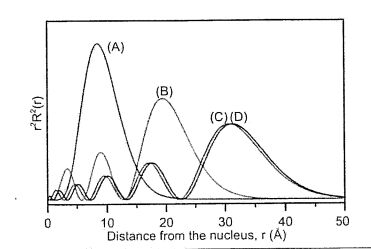 (A)A(B)B(C)C(D)D
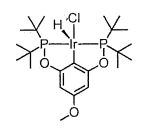 (A)0(B)+1(C)+2(D)+3
 (A)A(B)B(C)C(D)D
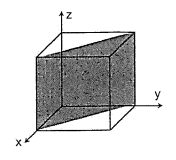 (A)(110)(B)(011)(C)(201)(D)(111)