所屬科目:研究所、轉學考(插大)◆無機化學
1. Metal-Organic Frameworks, the subject of the 2025 Nobel Prize in Chemistry, are best described by which structural characteristic? (A) Long protein chains folded into enzymatic shapes. (B) Two-dimensional sheets of carbon atoms arranged in a honeycomb lattice. (C) Porous crystalline materials composed of metal nodes linked by organic ligands. (D) Dense metallic alloys with high conductivity. (E) Amorphous solids with random atomic arrangements.
2. Determine the point group of boric acid, H₃BO₃. (A) C₃ᵥ (B) D₃ₕ (C) D₃d (D) C₃ₕ (E) C₃
3. Why is boric acid classified as an acid in aqueous solution? (A) It dissociates to release one of its own H⁺ ions from a hydroxyl group. (B) It acts as a Lewis acid by accepting an OH⁻ ion from water, effectively releasing a proton. (C) It contains three replaceable hydrogen atoms that all dissociate simultaneously. (D) It is not acid. (E) It reacts with bases to form salt and water through a simple neutralization of its H atoms.
4. Using the flowchart for determining the point group. What is the next step if the molecule does not contain n perpendicular C₂ axes? (A) Does the molecule contain a horizontal reflection plane (σₕ)? (B) Does the molecule contain n dihedral reflection planes (σd)? (C) Does the molecule contain a reflection plane? (D) Does the molecule contain a proper rotation axis (Ĉₙ)? (E) Does the molecule contain n vertical reflection planes (σᵥ)?
5. What is the following reaction mechanism? (A) Oxidative insertion (B) Reductive elimination (C) Migratory insertion (D) Transmetallation (E) Substitution
6. The atomic radius of aluminum (Al) is 143 pm, while that of gallium (Ga) is 122 pm. Why is Al larger than Ga, despite Ga being below Al in Group 13? (A) Ga is a transition metal, which inherently has a smaller radius than p-block elements like Al. (B) The addition of the 3d subshell in Ga provides poor shielding, leading to a higher effective nuclear charge that pulls valence electrons closer. (C) Al has more electron shells occupied than Ga, causing its atomic radius to be larger. (D) Ga has a more stable electron configuration that allows its valence shell to contract more easily than Al's. (E) Ga is larger than Al.
7. What is the total number of electrons that can be in level n = 5? (A) 32 (B) 2 (C) 50 (D) 8 (E) 18
8. The valence electron configuration of an element is ns²(n-1)d¹⁰np². Which group does this element belong to? (A) 13 (B) 14 (C) 15 (D) 16 (E) 17
9. Order the following diatomic molecules from the shortest to longest bond: C₂, B₂, H₂, N₂. (A) N₂, C₂, B₂, H₂ (B) C₂, N₂, H₂, B₂ (C) H₂, N₂, C₂, B₂ (D) C₂, B₂, H₂, N₂ (E) H₂, N₂, B₂, C₂
10. Vibrational transitions in a given molecule typically require energies that correspond to which region of the electromagnetic spectrum? (A) Visible (B) UV (C) IR (D) X-ray (E) microwave
11. In palladium-catalyzed cross-coupling reactions, such as the Suzuki-Miyaura coupling or Heck reaction, why is the addition of a base typically essential? (A) To increase the oxidation state of the palladium catalyst from Pd(0) to Pd(II) to initiate oxidative addition. (B) To activate the organometallic nucleophile or to neutralize the hydrogen halide (HX) generated during the catalytic cycle. (C) To serve as a sacrificial oxidant that prevents the palladium from precipitating as palladium black. (D) To act as a bulky ligand that occupies coordination sites on the palladium to prevent over-reaction.
12. Which of the following energy terms in the Born-Haber cycle for the formation of NaCl₍s₎ is typically an exothermic process? (A) Enthalpy of sublimation of Na₍s₎ (B) Second ionization energy of Na₍g₎ (C) First ionization energy of Na₍g₎ (D) First electron affinity of Cl₍g₎ (E) Bond dissociation enthalpy of Cl₂₍g₎
13. In the solid state, why does cesium chloride (CsCl) adopt a coordination number of 8 while sodium chloride (NaCl) adopts a coordination number of 6? (A) The lattice energy of NaCl is higher than that of CsCl. (B) Cesium is more electronegative than sodium. (C) NaCl forms a body-centered lattice while CsCl forms a face-centered lattice. (D) The larger size of the Cs⁺ cation allows more Cl⁻ ions to surround it without anion-anion repulsion. (E) NaCl is more covalent in nature than CsCl.
14. What is the shape of SF₄? (A) Tetrahedral (B) Square planar (C) Seesaw (D) Trigonal pyramidal (E) Square pyramidal
15. According to the Hard-Soft Acid-Base (HSAB) theory, which of the following reactions is most likely to have an equilibrium constant (K) much greater than 1? (A) AlF₃ + 3 AgI ⇌ AlI₃ + 3 AgF (B) TiCl₄ + 4 LiI ⇌ TiI₄ + 4 LiCl (C) HgI₂ + CaF₂ ⇌ HgF₂ + CaI₂ (D) CuI + NaCl ⇌ CuCl + NaI (E) AgF + LiI ⇌ AgI + LiF
16. The Lewis acidity of boron trihalides follows the trend: BF₃ < BCl₃ < BBr₃. What is the primary reason for this unexpected order? (A) The 3p and 4p orbitals of Cl and Br are too small to overlap with B. (B) Electronegativity decreases from F to Br, making B more positive in BBr₃. (C) BBr₃ has a higher bond dissociation energy than BF₃. (D) The π-bonding between the halogen and B is most effective in BF₃. (E) Steric effect in BBr₃ is lower than that in BF₃.
17. Which of the following complexes can exist as a pair of fac and mer isomers? (en = ethylenediamine) (A) [Co(NH₃)₄Cl₂]⁺ (B) [Fe(CN)₅(NO)]²⁻ (C) [Cr(en)₃]³⁺ (D) [Co(NH₃)₃(NO₂)₃] (E) [Pt(NH₃)₂Cl₂]
18. The complex [Co(en)₂Cl₂]⁺ exists as several isomers. Which of the following statements is correct regarding its stereochemistry? (A) The cis isomer is a meso compound and is optically inactive. (B) The cis isomer is chiral and exists as a pair of enantiomers (Δ and Λ). (C) The trans isomer is chiral and has a non-superimposable mirror image. (D) The complex can only exist as structural isomers, not stereoisomers. (E) Both the cis and trans isomers are optically active.
19. Which of the following describes the correct d-orbital splitting pattern in a square planar crystal field, from lowest energy to highest? (A) (B)(C)(D)(E)
20. In the molecular orbital diagram of an octahedral complex, how does π-backbonding from the metal to a ligand like CO affect the value of Δoct? (A) It increases Δoct by increasing the repulsion between ligands. (B) It increases Δoct by lowering the energy of the t₂g orbitals. (C) It has no effect on Δoct as π-bonding only involves eg* orbitals. (D) It decreases Δoct by lowering the energy of the eg* orbitals. (E) It decreases Δoct by raising the energy of the t₂g orbitals.
21. Why are Tanabe-Sugano diagrams often preferred over Orgel diagrams for interpreting the spectra of d² to d⁸ complexes? (A) Orgel diagrams are only used for d⁰ and d¹⁰ systems. (B) Orgel diagrams do not include spin-allowed transitions. (C) Tanabe-Sugano diagrams are simpler because they ignore electron-electron repulsions. (D) Tanabe-Sugano diagrams treat the Racah parameter B as a variable, allowing for the inclusion of both high-spin and low-spin states. (E) Orgel diagrams are only valid for tetrahedral complexes.
22. What is the major product formed when [PtCl₄]²⁻ reacts with one equivalent of NH₃, followed by one equivalent of NO₂⁻? (A) fac-[PtCl₃(NH₃)(NO₂)]⁻ (B) cis-[PtCl₂(NO₂)₂]²⁻ (C) cis-[PtCl₂(NH₃)(NO₂)]⁻ (D) [Pt(NH₃)₂(NO₂)₂] (E) trans-[PtCl₂(NH₃)(NO₂)]⁻
23. In the reaction [Co(NH₃)₅Cl]²⁺ + [Cr(H₂O)₆]²⁺ → [Co(NH₃)₅(H₂O)]²⁺ + [Cr(H₂O)₅Cl]²⁺, the chloride ion ends up attached to Cr. This is classic evidence for which mechanism? (A) Inner-sphere electron transfer (B) Outer-sphere electron transfer (C) Berry pseudorotation (D) Associative ligand substitution (E) Reductive elimination
24. The complex Co₂(CO)₈ exists in different isomeric forms. In the solid state, it contains two bridging CO ligands. How many Co-Co bonds are required to satisfy the 18-electron rule for each Co atom? (A) 4 (B) 1 (C) 3 (D) 2 (E) 0
25. Wilkinson's catalyst, RhCl(PPh₃)₃, can be used for the selective hydrogenation of alkenes. Which statement regarding its mechanism is true? (A) It is an example of a heterogeneous catalyst. (B) The first step in the cycle is the coordination of the alkene to the 16-electron complex. (C) The metal center is oxidized to Rh(III) during the oxidative addition step. (D) The catalyst obeys the 18-electron rule in its resting state. (E) The active species formed in solution is a 14-electron complex RhCl(PPh₃)₂.
(1) (4 points) Draw the most stable Lewis structure for this molecule. What are the oxidation states and formal charges of each element?
(2) (6 points) Construct the molecular orbital diagram of CO. Fill in the electrons and calculate the bond order. Please draw clearly to receive full credit. Use the following orbital potential energies to construct the MO diagram: C: 2s = -19.4 eV, 2p = -10.7 eV O: 2s = -32.4 eV, 2p = -15.8 eV
(3) (4 points) Why does CO usually coordinate to the transition metal through C but not O?
(1) (6 points) Write the mechanism for the substitution reaction between trans-PtCl₂(pip)₂ and NaNO₂.
(2) (4 points) Explain why there are two rate constants, k₁ and k₂.
(3) (4 points) Plot a graph of [NaNO₂] (x-axis) against kobs (y-axis) and use this to calculate k₁ and k₂.
(1) (4 points) W(η⁶-C₆H₆)(CO)n (C₆H₆ = benzene)
(2) (4 points) Rh(η⁵-C₅H₅)(CO)n (C₅H₅⁻ = cyclopentadienide)
(3) (4 points) Ru₃(CO)n (Hint: the three Ru centers form a triangle with three Ru-Ru bonds)
29. (10 points) The chromium centers in the crystal structure of KCrF₃ are in an octahedral environment of fluorine atoms. Four of the Cr-F bond distances are 214 pm, and the remaining two trans Cr-F bond distances are 201 pm. Explain these observations and include a crystal field splitting diagram.
 阿摩線上測驗
登入
阿摩線上測驗
登入
 (A) C₃ᵥ (B) D₃ₕ (C) D₃d (D) C₃ₕ (E) C₃
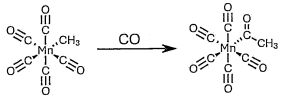 (A) Oxidative insertion (B) Reductive elimination (C) Migratory insertion (D) Transmetallation (E) Substitution
 (B)
(B) (C)
(C) (D)
(D) (E)
(E)