阿摩線上測驗
登入
首頁
>
中山◆電機◆電子學
>
107年 - 107 國立中山大學_碩士班招生考試_電波領域:電子學#108992
> 申論題
題組內容
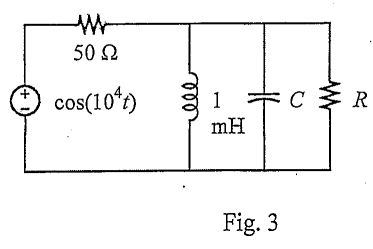
3. (30%)
(b) (10%) Calculate this maximum power.
相關申論題
(a)(20%) Draw the ac equivalent circuit. Deternine the frequency (in rad/s) at which the amplifier achieves the peak gain, and determine this maximum gain.
#467102
(b) (10%) Find the bandwidth of the amplifier (in rad/s). Note:for Q in saturation.
#467103
2. (20%) Use the Barkhausen criterion to determine the values of R and C so that the Wien-bridge circuit in Fig. 2 oscillates at 100 kHz.
#467104
(a) (20%) Determine the values of R and C in Fig. 3 so that the average power dissipation on resistor R is maximized.
#467105
4. (20%) An emitter follower in Fig. 4 is used to drive a very high impedance. Ci forms a high-pass filter with the divider resistances and the resistance looking into the base. Choose the value of C1 so that the resulting cutoff frequency is 1 KHz.
#467107
4. (30%) Figure 4 shows a CC-CE amplifier with = RL = 5 kΩ, I1 = I2 = 1mA, and identical transistors with β = 100, fT = 500 MHz, Cμ = 5pF, and Cc = 2uF. The thermal voltage VT= 25mV. For simplicity, neglect ro and rx effect. Please find (a) the input resistance(b) the midband gain AM, (c) the Cπof the BJTs, and (d) 3-dB frequency of the upper end of the midband, fH (using open-circuit time- constants method). (5%, 5%, 5%, 15%)
#471815
3. (30%) Figure 3 is the two-stage CMOS op amp configuration. All NMOSFETs have the same W/L = 10um/0.5um, = 0.5V, = 200 uA/V2. All PMOSFETs have the same WIL = 40um/0.5pμm, = -0.5V, = 50 μA/V2. IVAI (for all devices) = 100μ.A. Neglect the effect of VA on bias current. Please find (a) the transconductance gm and ro of Q2, (b) the voltage gain of the furst stage A1 and the second stage A2, (c) the input common-mode range, and (d) the output voltage range.(10%, 10%, 5%, 5%)
#471814
2.(25%) Consider the voltage amplifier of Figure 2 with a BJT device having β =100 when it is biased in the active region, the AC signal voltage Vsig, signal resistance = 10kΩ and coupling capacitors and which can block DC component and pass AC component. The voltage supplies = 10V and the thermal voltage VT= 25mV. The constant voltage drop 0.7V approximation can be used for the turn- on of a p-n junction, and the constant voltage drop ~ 0.2V approximation can be used when the BJT is biased in the saturation region. In addition, other resistances are also included, such like R1 = 2MΩ, R2 = 2MΩ, RE = 5kΩ, Rc = 5kΩ, RL= 5kΩ. Please come out following parameters: (a) transconductance gm, (b) input resistance, (c) overall AC voltage gain (d) Please describe the advantages of the existing of emitter resistance Re compared with no RE. (5%, 5%, 5%, 10%)
#471813
1. (15%) Figure 1 shows the inverting configuration voltage amplifier with R = 1 kΩ. (a) Please find the close loop gain of Vo/VI if the operational amplifier (op amp) is ideal. (b) Please find the close loop gain of Vo/VI if the open loop gain of op amp is 10 V/V. (c) If the op amp is a low-pass STC withT , please find the high frequency close loop gain of Vo/VI at f= 1 GHz. (5%, 5%, 5%)
#471812
4.(30%) Figure 3 shows the common-source amplifer with an ideal current source I = 0.4 mA, = 200 kΩ, RG = 2 MΩ, RD =RL = 20 kΩ, C1 = C2 = C3 = 1 HF. The MOSFET has the device parameters: I = 0.2 μm, W = 2 μm, = 10 fP/μm2, μn = 450 cm2/V-s, r0 = 100 kΩ, = 3.2 fF, can be neglected, and the source terminal of MOSFET is connected to its body terminal. Please calculate (1) the transconductance gm of the MOSFET, (2) the AM, f1,f2,f3 (let f1 <f2<f3) values of the overall low- frequency transfer function , (3) the upper 3-dB frequency fr by using open-circuit time constants method. (5%, 5%*4, 5%)
#471811
相關試卷
110年 - 110 國立中山大學_碩士班招生考試_電機系(甲組):電子學(甲組)#106054
110年 · #106054
110年 - 110 國立中山大學_碩士班招生考試_電機系(戊組)、通訊所(乙組)、電波聯合:電子學#104281
110年 · #104281
109年 - 109 國立中山大學_碩士班招生考試_電機系(甲組):電子學(甲組)#106048
109年 · #106048
107年 - 107 國立中山大學_碩士班招生考試_電機系(甲組):電子學#110217
107年 · #110217
107年 - 107 國立中山大學_碩士班招生考試_電波領域:電子學#108992
107年 · #108992
106年 - 106 國立中山大學_碩士班招生考試_電波領域:電子學#110216
106年 · #110216
106年 - 106 國立中山大學_碩士班招生考試_電機系(甲組):電子學#108988
106年 · #108988
105年 - 105 國立中山大學_碩士班招生考試_電機系(甲組)(己組):電子學#110214
105年 · #110214
104年 - 104 國立中山大學_碩士班招生考試_電機系(甲組、乙組、戊組)、電波領域:電子學#110220
104年 · #110220
103年 - 103 國立中山大學_碩士班招生考試_電機系(甲、乙、戊組)、電波領域:電子學#110218
103年 · #110218
 阿摩線上測驗
登入
阿摩線上測驗
登入