阿摩線上測驗
登入
首頁
>
學士後西醫-有機化學
>
102年 - 102 學士後西醫:有機化學#27324
> 試題詳解
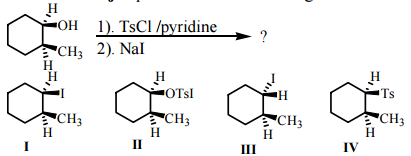
3. Predict the major product for the following reaction.
(A) I
(B) II
(C) III
(D) IV
(E) Both I and III
答案:
登入後查看
統計:
A(4), B(1), C(23), D(0), E(3) #943131
私人筆記 (共 1 筆)
白白
2026/01/08
私人筆記#7715277
未解鎖
TsCl 將OH轉成好的離去基,且組態保...
(共 48 字,隱藏中)
前往觀看
1
0
相關試題
I. Choose one correct answer for the following questions 【單選題】每題 1 分,共計 60 分,答錯 1 題倒扣 0.25 分,倒扣至本大題零分為止,未作答,不給分亦不扣分。1. What is the major product obtained from the following reaction sequence? (A) I (B) II (C) III (D) IV (E) V
#943129
2. The hydroboration-oxidation procedure can be successfully employed for synthesis of deuterated derivatives, by using BD3 instead of BH3. What major product would you expect from the following reaction? (A) I (B) II (C) III (D) IV (E) V
#943130
4. The following atoms are commonly encountered in organic molecules. For which is it not possible to isolate enantiomers due to rapid inversion? (A) trivalent phosphorus (B) trivalent nitrogen (C) divalent sulfur (D) trivalent sulfur (E) both B and C
#943132
5. Which of these alkyl halides can NOT be used to prepare amines using Gabriel synthesis? (A) 1-bromopentane (B) 1-bromo-3-methylbutane (C) 2-bromo-3-methylpentane (D) 1-bromo-2,3-dimethylbutane (E) 2-bromo-2,3-dimethylbutane
#943133
6. Which of the following structures is a Fischer projection of (2S,3S,4R)-hexane-2,3,4-triol. (A) I (B) II (C) III (D) IV (E) V
#943134
7. Treatment of (S)-6-chloro-1-methyl-1-cyclohexene with H3O is expected to produce which of the following product(s)? (A) I and III (B) II (C) II and V (D) IV (E) I, III and V.
#943135
8. Which of the following substituent has the highest priority according to the Cahn-Ingold-Prelog system? (A) –COOH (B) –CHO (C) –CH2OH (D) –CH3 (E) -H
#943136
9. What is the IUPAC name of the expected major product formed upon reaction of HCl with 3-methyl-1-butene?(A) 1-Chloro-2-methylbutane (B) 1-Chloro-3-methylbutane (C) 2-Chloro-2-methylbutane (D) 2-Chloro-3-methylbutane (E) 1-Chloropentane
#943137
10. Which sequence correctly ranks the following substrates in order of increasing reactivity in an SN1 reaction? (A) 3 < 2 < 1 (B) 2 < 3 < 1 (C) 2 < 1 < 3 (D) 1 < 3 < 2 (E) 1 < 2 < 3
#943138
11. A pure sample of (S)-phenylalanine has a specific rotation of +70o . A mixture of the two enantiomers of phenylalanine gives a specific rotation of -7.0o . What are the percentages of the S and R enantiomers in the mixture? (A) 75 % S, 25 % R (B) 65 % S, 35 % R (C) 55 % S, 45 % R (D) 45 % S, 55 % R (E) 35 % S, 65 % R
#943139
相關試卷
105年 - 105 學士後西醫:有機化學#78642
2016 年 · #78642
104年 - 104 學士後西醫:有機化學#27032
2015 年 · #27032
103年 - 103 學士後西醫:有機化學#27037
2014 年 · #27037
102年 - 102 學士後西醫:有機化學#27324
2013 年 · #27324
101年 - 101 學士後西醫:有機化學#27197
2012 年 · #27197
100年 - 100 學士後西醫:有機化學#35480
2011 年 · #35480
98年 - 098 學士後西醫:有機化學#37156
2009 年 · #37156
96年 - 96學士後西醫-有機化學 #37201
2007 年 · #37201
 阿摩線上測驗
登入
阿摩線上測驗
登入