阿摩線上測驗
登入
首頁
>
學士後西醫-有機化學
>
98年 - 098 學士後西醫:有機化學#37156
> 試題詳解
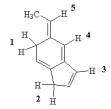
45. Which of the labeled H atoms (1-5) in the following molecule would be predicted to be the most acidic?
(A) 1
(B) 2
(C) 3
(D) 4
(E) 5
答案:
登入後查看
統計:
A(22), B(7), C(0), D(0), E(0) #1072933
詳解 (共 1 筆)
大家加油! 邀請碼228480
B1 · 2025/12/17
#7261434
這題考察的是有機化學中酸性(Acidi...
(共 997 字,隱藏中)
前往觀看
1
0
相關試題
8. SN1 reaction usually proceed with . (A) slightly more inversion than retention at the center undergoing substitution (B) slightly more retention then inversion at the center undergoing substitution (C) equal amounts of inversion and retention at the center undergoing substitution (D) complete inversion at the center undergoing substitution (E) complete retention at the center undergoing substitution
#1072896
9. Peptide bonds are . (A) ester linkages (B) imido linkages (C) amide linkages (D) ether linkages (E) disulfide linkages
#1072897
10. What is the major product of the following reaction?
#1072898
11. What compound is produced when (CH3)2CHCH2Br is subjected to the following sequence of steps: 1. Mg, Et2O, 2. CO2, 3. H3O+ ? (A) 2-methylpropanoic acid (B) 3-methylpropanoic acid (C) 2-methylbutanoic acid (D) 3-methylbutanoic acid (E) 2-methylhexanoic acid
#1072899
12. Which of the following alcohols will react most rapidly with the Lucas reagent (HCl, ZnCl2)?
#1072900
13. The structures below are . (A) not isomers (B) conformational isomers (C) structural isomers (D) cis-trans isomers (E) both B and D
#1072901
14. The Hell-Volhard-Zelinsky reaction involves . (A) the α-bromination of carboxylic acids (B) the α-bromination of ketones (C) the bromination of alcohols (D) the oxidation of aldehydes to acids (E) none of the above
#1072902
15. When indole is treated with bromine in dioxane at 0o C, the major organic product is . (A) 2-bromoindole (B) 3-bromoindole (C) 4-bromoindole (D) 5-bromoindole (E) 6-bromoindole
#1072903
16. Which compound has a 1 H NMR spectrum consisting of the following peaks: 0.9 (6H, d), 1.0 (3H, t), 2.2 (2H, q), and 4.0 (1H, septet)?
#1072904
17. How many distinct alkene products are possible when the alkyl iodide below undergoes E2 elimination? (A) 1 (B) 2 (C) 3 (D) 4 (E) 5
#1072905
相關試卷
105年 - 105 學士後西醫:有機化學#78642
2016 年 · #78642
104年 - 104 學士後西醫:有機化學#27032
2015 年 · #27032
103年 - 103 學士後西醫:有機化學#27037
2014 年 · #27037
102年 - 102 學士後西醫:有機化學#27324
2013 年 · #27324
101年 - 101 學士後西醫:有機化學#27197
2012 年 · #27197
100年 - 100 學士後西醫:有機化學#35480
2011 年 · #35480
98年 - 098 學士後西醫:有機化學#37156
2009 年 · #37156
96年 - 96學士後西醫-有機化學 #37201
2007 年 · #37201
 阿摩線上測驗
登入
阿摩線上測驗
登入