(c) (5 points) Now we introduce one more good, the houses, into the economy. As in question
(b), an agent endows units of consumption goods at the beginning of period t = 0, 1, 2.
Moreover, an agent also owns e units of houses in the beginning of period 0. Houses are divisible,
and houses provide living services to their holders: let h, denote an agent's holding of houses at
the beginning of each period, then holding ht unit of houses generates ou(h.) units of utility to
the agent. Where a > O represents the relative importance of housing utility to consumption
utility. We assume that houses are perfectly durable, and that means houses do not vanish or
depreciate over time or after they provide the living service.
units of consumption goods at the beginning of period t = 0, 1, 2.
Moreover, an agent also owns e units of houses in the beginning of period 0. Houses are divisible,
and houses provide living services to their holders: let h, denote an agent's holding of houses at
the beginning of each period, then holding ht unit of houses generates ou(h.) units of utility to
the agent. Where a > O represents the relative importance of housing utility to consumption
utility. We assume that houses are perfectly durable, and that means houses do not vanish or
depreciate over time or after they provide the living service.
Let an agent's consumption be ct, and let her house holdings at the beginning of a period be
ha, then the agent's lifetime utility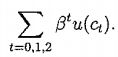 After agents receive the living service in each period, the housing market opens. The housing
market allows agents to exchange between houses and consumption goods. Let pt denote the
price of houses in terms of consumption goods at period t. Solve for po and p1.
After agents receive the living service in each period, the housing market opens. The housing
market allows agents to exchange between houses and consumption goods. Let pt denote the
price of houses in terms of consumption goods at period t. Solve for po and p1.
 阿摩線上測驗
登入
阿摩線上測驗
登入