阿摩線上測驗
登入
首頁
>
學士後西醫-有機化學
>
105年 - 105 學士後西醫:有機化學#78642
> 試題詳解
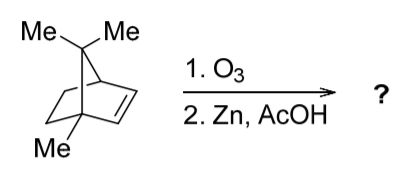
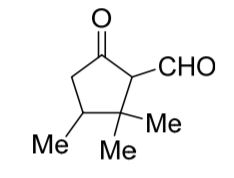
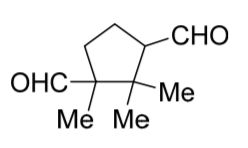
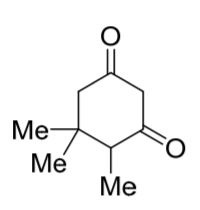
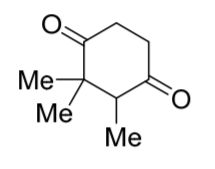
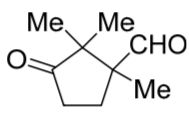
8. Choose the correct product of the following reaction?
(A)
(B)
(C)
(D)
(E)
答案:
登入後查看
統計:
A(3), B(23), C(1), D(0), E(2) #2053805
詳解 (共 1 筆)
阿姨我不想努力了
B1 · 2026/02/01
#7289759
笑死,
會切,但沒反應過來橋頭變成新的環,
一直想說是後續還會有甚麼酷酷的反應嗎,
結果只是圖形轉換不過來
0
0
私人筆記 (共 1 筆)
白白
2024/10/18
私人筆記#6445418
未解鎖
(共 0 字,隱藏中)
前往觀看
4
0
相關試題
1. Rank the following monomers in order of increasing reactivity toward cationic polymerization (least reactive to most reactive). (A) III, IV, I, II (B) II, I, IV, III (C) I, II, IV, III (D) IV, III, I, II (E) I, II, III, IV
#2053798
2. What product would be obtained for the following reaction?(A) CH3(CH2)3C≡CCH2OH (B) CH3(CH2)3C≡CCHO (C) CH3(CH2)3C≡CH (D) CH3(CH2)3C≡CNMe2 (E) None of the above.
#2053799
3. Which two have the same molecular geometry? (A) I, II (B) III, IV (C) I, V (D) II, V (E) IV, V
#2053800
4. Which nitrogen(s) have more basic? (A) I (B) II (C) III (D) I, II, and III are acidic (E) None of the above.
#2053801
5. Rank the acidity of the following compounds. (A) I > IV > III > II (B) I > III > IV > II (C) IV > II > I > III (D) II > I > IV > III (E) None of the above.
#2053802
6. What is the order of increasing acidity for the following compounds? (A) IV < I < II < III (B) III < II < I < IV (C) III < II < IV < I (D) IV < II < I < III (E) I < IV < II < III
#2053803
7. Which of these substances contains both covalent and ionic bonds? (A) HN3 (B) NH4Cl (C) H2O2 (D) XeF2 (E) PCl5
#2053804
9. How many monochloro substituted products C6H13Cl you might obtain by reaction of 2-methylpentane with Cl2? (A) 1 (B) 2 (C) 3 (D) 4 (E) 5
#2053806
10. There are some isomers of 4-t-butylcyclhexane-1,3-diol. Which isomer reacts readily with acetone and an acid catalyst to form an acetal, but other stereoisomers do not react? (A) (B) (C) (D) (E)
#2053807
11. Which of the following correctly describes a molecule that is achiral? (A) Non-superimposability of the molecule on its mirror image (B) Superimposability of the molecule on its mirror image (C) Contains a carbon atom with four different substituents (D) Does not have a plane of symmetry (E) Both {B} and {D}.
#2053808
相關試卷
105年 - 105 學士後西醫:有機化學#78642
2016 年 · #78642
104年 - 104 學士後西醫:有機化學#27032
2015 年 · #27032
103年 - 103 學士後西醫:有機化學#27037
2014 年 · #27037
102年 - 102 學士後西醫:有機化學#27324
2013 年 · #27324
101年 - 101 學士後西醫:有機化學#27197
2012 年 · #27197
100年 - 100 學士後西醫:有機化學#35480
2011 年 · #35480
98年 - 098 學士後西醫:有機化學#37156
2009 年 · #37156
96年 - 96學士後西醫-有機化學 #37201
2007 年 · #37201
 阿摩線上測驗
登入
阿摩線上測驗
登入