阿摩線上測驗
25. Which is NOT compatible with the assumption of the interlanguage theory proposed by Larry Selinker?
(A) Learners’ use of ‘eated’ in place of ‘ate’ is an error due to overgeneralization.
(B) Learners’ grammar is likely to fossilize during L1 and L2 acquisition.
(C) Learners employ various learning strategies to develop their interlanguages.
(D) Interlanguage is characterized with transitional continuum.
統計: A(49), B(318), C(105), D(73), E(0) #2307624
詳解 (共 8 筆)


Interlanguage
https://www.youtube.com/watch?v=zqVRV1Wzthc
https://www.youtube.com/watch?v=CBPhIF5du_w
(參考以下連結會更好懂)
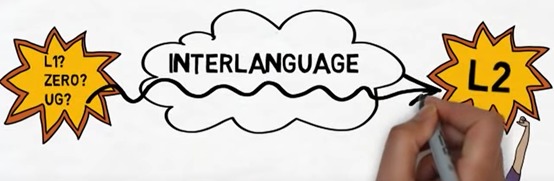
1. Definition:
Interlanguage (IL) is a linguistic system used by second language learners. Learners create this language when they attempt to communicate in the target language. Interlanguage is affected by the learner's native language as they use their native language knowledge to understand and organize the second language or to compensate for existing competency gaps.
2. Interlanguage Formation:

(1) Overgeneralization: Overgeneralization involves learners extending the application of a rule in L2. They group similar items together and try to predict their behavior based on a rule they already know. Using the same rule in new situations leads to errors: (e.g., the plural for ''deer'' becomes ''deers''; the past tense of ''go'' becomes ''goed.'' An English learner using the verb ‘drive’ not just with the word ‘car’ but also with the word ‘bicycle’)
(2) Learning strategies: Learning strategies consist of learners adopting different learning approaches. Some incorrect learning strategies may result in stagnation in the development of some aspect of L2, such as syntactic, lexical, or sociocultural. One such example is the act of simplification, as in ''I am clean my room now'' instead of ''I am cleaning my room now.''
(3) Language transfer: Language transfer involves learners using their knowledge of L1 to understand or produce meaning in L2. If L1 and L2 are very different, errors are likely to occur in L2, like ''I cats love.''
(4) Transfer of training: Transfer of learning is relevant to L2 teaching in multiple ways. It has been common to view transfer as the influence – often negative – of knowledge of one language on the learning and use of another language (e.g., a Spanish speaker producing an English sentence with Spanish word order, ‘The car red is mine’.Eastern European learners of English overusing the pronoun ‘he’ because their textbooks and teachers almost always used that pronoun. )
(5) Communication strategies:
Foreign language learners may encounter various communication problems when their interlanguage is limited. In order to convey their messages and remain in a conversation until their communication goal is achieved, ESL (English as a Second Language) learners need to employ communication strategies, which have been defined generally as devices used by second language learners to overcome perceived barriers to achieving specific communication goals (Færch &Kasper, 1983)

The interlanguage theory proposed by Larry Selinker focuses on the process of second language (L2) acquisition, not first language (L1) acquisition. Interlanguage is a dynamic and evolving linguistic system that learners construct as they progress toward the target language. Here's how the options align with the theory:
-
(A) Learners’ use of ‘eated’ in place of ‘ate’ is an error due to overgeneralization.
✔ This is compatible. Overgeneralization (e.g., applying regular past tense rules to irregular verbs) is a common feature in interlanguage development. -
(B) Learners’ grammar is likely to fossilize during L1 and L2 acquisition.
✘ This is NOT compatible because fossilization is a phenomenon specific to L2 acquisition in interlanguage theory. Selinker emphasized that certain errors in L2 learners’ interlanguage might become "fossilized," meaning they persist even after extensive exposure or practice. Fossilization does not typically occur in L1 acquisition, as native speakers continue to develop proficiency throughout their lives. -
(C) Learners employ various learning strategies to develop their interlanguages.
✔ This is compatible. Selinker highlighted that learners use strategies such as overgeneralization, simplification, and transfer to build their interlanguage. -
(D) Interlanguage is characterized with transitional continuum.
✔ This is compatible. Interlanguage evolves over time as learners receive more input and refine their understanding of the target language, forming a transitional continuum between their native language and the target language.
Thus, (B) is the option that is NOT compatible with Selinker’s interlanguage theory.