阿摩線上測驗
登入
首頁
>
學士後西醫-生物學
> 102年 - 102 學士後西醫:普通生物學#27058
102年 - 102 學士後西醫:普通生物學#27058
科目:
學士後西醫-生物學 |
年份:
102年 |
選擇題數:
75 |
申論題數:
0
試卷資訊
所屬科目:
學士後西醫-生物學
選擇題 (75)
1. A fossil that has one fourth the normal proportion of carbon-14 to carbon-12 is approximately _____years? (Carbon-14 half life is about 5,700 years) (A) 1,350 (B) 2,750 (C) 11,400 (D) 16,800 (E) 22,400
2. Natural selection involves energetic trade-offs between ______ (A) the reproductive strategy of semelparity and iteroparity. (B) the population increaing and decreasing. (C) high survival rates of offspring and the cost of parental care. (D) number of reproductive females and reproductive ability. (E) the number of offspring and how long they live.
3. Which option listed in below is NOT an antipredator defensive behavior? (A) Camouflage (B) Aposematic coloration (C) Bastesian mimicry (D) Mullerian mimicry (E) Character displacement
4. Which of the following descriptions about "toxin in the environment" is INCORRECT? (A) The biological magnification is the toxin become more concentrated in trophic level of food web. (B) Chlorinated hydrocarbons has demonstrated biological magnification. (C) Some low toxic chemicals transform high toxic by exploring sunlight or microbial metabolism. (D) Chemicals released into the environment may be relatively harmless but converted to more toxic product by reaction with other substances, by exposure to light, or by the metabolism of microorganism. (E) WHO allows that DDT strictly reuse in disease vector control in 2007, so DDT is not environmental toxin anymore.
5. Which of the following descriptions about "regulating of enzyme activity in metabolism" is INCORRECT? (A) Allosteric regulation is the term used to describe any case in which a protein’s function at one site is affected by the binding of a regulatory molecule to a separate site. (B) An activating or inhibiting regulatory molecule binds to a regulatory site that is the simplest kind of allosteric regulation. (C) Feedback inhibition is a common mode of metabolic control. (D) Cooperativity is a type of enzyme activation, not including inhibition. (E) Cooperativity is the binding of one substrate molecule that can stimulate binding or activity at other active sites.
複選題
6. Mendel used the scientific approach to indentify two laws of inheritance, which comment about "Mendelian genetics" is NOT correct? (A) Mendelian genetics includes two laws as law of segregation and law of independent assortment. (B) The law of segregation states that genes have alternative forms, or alleles. (C) The law of independnet assortment states the pair of alleles for a given gene segregates into gametes independently of the pair of alleles for any other gene. (D) Traits are inherited in discrete units, and are not the results of blending. (E) In heterozygotes, the two alleles are different, and the expression of two different alleles makes phenotypic effects of the other.
7. Which sex determination system is suitable for the following descriptions? There is only one type of sex chromosome, the females have two sex chromosomes, males have only one sex chromosome. Sex of the offsprings is determined by whether the sperm cell contains an X chromosome or no sex chromosome. (A) The X-Y system (B) The X-0 system (C) The Z-W system (D) The haplo-diploid system (E) None
8. Bacteria is one of major group of prokaryotes, which of the following description about "bacterial DNA replication" is NOT correct? (A) Helicase unwinds the parental double helix DNA. (B) Primase begins synthesis of the RNA primer for the Okazaki fragment in lagging strand. (C) The leading strand is synthesized continuously in the 5’ to 3’ direction by DNA polymerase II. (D) DNA polymerase I removes the primer from the 5’ end of the second fragment, replacing it with DNA. (E) DNA ligase joins the 3’ end of the second fragment to the 5’ end of the first fragment.
9. Which genes should be turned on first to determinate the body axis during embryogenesis of Drosophila? (A) Pair rule genes (B) Segmentation genes (C) Segmentation polarity genes (D) Maternal effect genes (E) Homeotic genes
10. The eyes of mammalian and octopus are similar in structure and function. Which of following hypothesis accounts for most of this similarity? (A) Balanced polymorphism (B) Convergent evolution (C) Parallel evolution (D) Cladogenesis (E) Macroevolution
複選題
11. A new species of plant could be originated by hybridization coupled with ________ (A) autopolyploidy. (B) polymorphic speciation. (C) a super species. (D) sympatric speciation. (E) allopatric speciation.
12. The dengue virus fragments will be presented by virus-infected cells along with which of the following? (A) Toll receptor (B) Complement (C) Antibodies (D) Class I MHC molecules (E) Class II MHC molecules
13. The sum of a species’ use of the biotic and abiotic resources in its environment is called the species’ _________? (A) niche (B) ecological niche (C) resource niche (D) environment niche (E) ecological statement
14. Which statement about variation is true? (A) All new alleles are the result of nucleotide variability. (B) All phenotypic variation is the result of genotypic variation. (C) All genetic variation produces phenotypic variation. (D) All nucleotide variability results in neutral variation. (E) All geographic variation results from the existence of clines.
15. In a hypothetical situation, the genes for sex pilus construction and for tetracycline resistance are located together on the same plasmid within a particular bacterium. If this bacterium readily performs conjugation involving a copy of this plasmid, then the result should be ____. (A) the rapid spread of tetracycline resistance to other bacteria in that habitat. (B) the subsequent loss of tetracycline resistance from this bacterium. (C) the production of endospores among the bacterium's progeny. (D) the temporary possession by this bacterium of a completely diploid genome. (E) a transformed bacterium.
16. Mendel's observation of the segregation of alleles in gamete formation has its basis in which of the following phases of cell division? (A) Anaphase of mitosis (B) Prophase I of meiosis (C) Prophase II of meiosis (D) Metaphase I of meiosis (E) Anaphase I of meiosis
17. Abnormal chromosomes are frequent in malignant tumors. Errors such as translocations may place a gene in close proximity to different control regions. Which of the following might then occur to make the cancer worse? (A) Sensitivity of the immune system (B) An increase in non-disjunction (C) Expression of inappropriate gene products (D) A decrease in mitotic frequency (E) Death of the cancer cells in the tumor
18. A chemist wishes to make an organic molecule less acidic. Which of the following functional groups should be added to the molecule in order to do so? (A) phosphate (B) amino (C) sulfonyl (D) sulfhydryl (E) carboxyl
19. RFLP analysis can be used to distinguish between alleles based on differences in which of the following? (A) the ability of nucleic acid probes to hybridize to the alleles (B) the proteins expressed from the alleles (C) the ability of the alleles to be replicated in bacterial cells (D) the amount of DNA amplified from the alleles during PCR (E) restriction enzyme recognition sites between the alleles
20. The volume enclosed by the plasma membrane of plant cells is often much larger than the corresponding volume in animal cells. The most reasonable explanation for this observation is that ____. (A) plant cells contain a large vacuole that increases the volume of the cell. (B) plant cells are capable of having a much higher surface-to-volume ratio than animal cells. (C) plant cells have a much more highly convoluted (folded) plasma membrane than animal cells. (D) animal cells are more spherical, while plant cells are elongated. (E) the basic functions of plant cells are very different from those of animal cells.
21. In the thylakoid membranes, what is the main role of the antenna pigment molecules? (A) concentrate photons within the stroma (B) split water and release oxygen to the reaction-center chlorophyll (C) harvest photons and transfer light energy to the reaction-center chlorophyll (D) synthesize ATP from ADP and Pi (E) transfer electrons to ferredoxin and then NADPH
22. How do the daughter cells at the end of mitosis and cytokinesis compare with their parent cells when it was in G1 of the cell cycle? (A) The daughter cells have the same number of chromosomes and half the amount of DNA. (B) The daughter cells have the same number of chromosomes and the same amount of DNA. (C) The daughter cells have the same number of chromosomes and twice the amount of DNA. (D) The daughter cells have half the amount of cytoplasm and half the amount of DNA. (E) The daughter cells have half the number of chromosomes and half the amount of DNA.
23. What is a karyotype? (A) The combination of chromosomes found in a gamete. (B) A system of classifying cell nuclei. (C) A display of every pair of homologous chromosomes within a cell, organized according to size and shape. (D) The set of unique physical characteristics that define an individual. (E) The collection of all the mutations present within the genome of an individual.
24. What is the function of DNA polymerase III? (A) to rejoin the two DNA strands (one new and one old) after replication (B) to degrade damaged DNA molecules (C) to add nucleotides to the end of a growing DNA strand (D) to seal together the broken ends of DNA strands (E) to unwind the DNA helix during replication
25. Phylogenetic trees are best described as ____. (A) true and inerrant statements about evolutionary relationships (B) hypothetical portrayals of evolutionary relationships (C) the closest things to absolute certainty that modern systematics can produce (D) theories of evolution (E) the most accurate representations possible of genetic relationships among taxa
26. As cleavage continues during frog development, the size of the blastomeres ____. (A) increases as the number of the blastomeres increases (B) decreases as the number of the blastomeres increases (C) decreases as the number of the blastomeres decreases (D) increases as the number of the blastomeres stays the same (E) increases as the number of the blastomeres decreases
27. Which of the following best describes resource partitioning? (A) Two species can coevolve to share the same niche. (B) Competitive exclusion results in the success of the superior species. (C) Slight variations in niche allow similar species to coexist. (D) A climax community is reached when no new niches are available. (E) Differential resource utilization results in the decrease in species diversity.
28. The producers in aquatic ecosystems include organisms in which of the following groups? (A) photoautotrophs (B) plants (C) alga (D) cyanobacteria (E) A, B, C, and D are all correct
29. Overexploitation encourages extinction and is most likely to affect ____. (A) most organisms that live in the oceans (B) terrestrial organisms more than aquatic organisms (C) edge-adapted species (D) animals that occupy a broad ecological niche (E) large animals with low intrinsic reproductive rates
30. You are observing a population of lizards when you notice that the number of adults has increased and is higher than previously observed. One explanation for such an observation would include ____. (A) increased birth rate (B) decreased emigration (C) increased emigration (D) increased immigration (E) reduction in death rate
31. Which of the following pair of hormones have antagonistic effects? (A) thyroid hormone and parathyroid hormone (B) epinephrine and norepinephrine (C) glucagon and insulin (D) prolactin and oxytocin (E) androgen and estrogen
32. Which of the following is true of members of the phylum Cnidaria? (A) They are not capable of locomotion because they lack true muscle tissue. (B) They are primarily filter feeders. (C) They have either, or both, of two body forms: mobile polyps and sessile medusae. (D) They may use a gastrovascular cavity as a hydrostatic skeleton. (E) They are the simplest organisms with a complete alimentary canal (two openings).
33. The enzyme amylase can break glycosidic linkages between glucose monomers only if the monomers are in the α form. Which of the following could amylase break down? (A) glycogen, starch, and amylopectin (B) glycogen and cellulose (C) cellulose and chitin (D) starch and chitin (E) starch, amylopectin, and cellulose
34. Which of the following statements about intermediate filaments is NOT TRUE? (A) They are cytoskeletal fibers with a diameter of 8-12 nm. (B) Their constituent proteins are highly heterogeneous and express in a cell-type specific manner. (C) Their main function is to maintain cell shape and anchor organelles such as mitochondria. (D) They also express in nucleus and form nuclear lamina. (E) Vesicle can travel along intermediate filaments through interaction with motor proteins.
35. Which of the following statements about glycolysis is NOT TRUE? (A) Glycolysis takes place in cytosol. (B) The ATP made during glycolysis is generated by substrate-level phosphorylation. (C) Glycolysis will proceed in eukaryotic cells whether oxygen is present or absent. (D) During glycolysis, when glucose is catabolized to pyruvate, most of the energy of glucose is transferred to ADP, forming ATP. (E) In addition to ATP, the end products of glycolysis are NADH and pyruvate.
36. About Calvin cycle, which of the following statement is true? (A) reactions occur within the thylakoid membrane. (B) carbon fixation catalyzed by rubisco is the first step of the reaction. (C) reaction includes split water and release of oxygen. (D) the cycle builds sugar from smaller molecules by using ATP and the reducing power of electrons carried by NADH. (E) photophosphorylation occurs and generates ATP.
37. About mitosis and meiosis, which statement is NOT TRUE? (A) Mitosis conserves the number of chromosome sets, producing cells that are genetically identical to the parent cell. (B) Meiosis reduces the number of chromosomes sets from two (diploid) to one (haploid), producing cells that differ genetically from each other and from the parent cell. (C) Meiosis occurs in reproductive cells, forming female and male haploid gametes. (D) DNA replication occurs twice in meiosis but once in mitosis. (E) Cell divides twice in meiosis but once in mitosis.
38. The first cloned cat, called Carbon Copy, was a calico, but she looked significantly different from her female parent. Why? (A) The environment, as well as genetics, affects phenotypic variation. (B) Fur color genes in cats are influenced by differential acetylation patterns. (C) X inactivation in the embryo is random and produces different patterns. (D) Cloned animals have been found to have a higher frequency of transposon activation. (E) The telomeres of the parent's chromosomes were shorter than those of an embryo.
39. The leading and the lagging strands differ in that (A) synthesize leading strands require RNA primer, but synthesize lagging strands do not require RNA primer. (B) the leading strand is synthesized by adding nucleotides to the 3' end of the growing strand, and the lagging strand is synthesized by adding nucleotides to the 5' end. (C) the lagging strand is synthesized continuously, whereas the leading strand is synthesized in short fragments that are ultimately stitched together. (D) the leading strand is synthesized in the same direction as the movement of the replication fork, and the lagging strand is synthesized in the opposite direction. (E) the leading strand is synthesized at twice the rate of the lagging strand.
40. About split gene and RNA splicing, which of the following statements is NOT TRUE? (A) The coding regions are called exons because they are expressed and usually translated into proteins. (B) The other regions called introns. They are noncoding regions, which contain intervening sequences that are nonfunctional. (C) RNA splicing removes introns and joins exons, creating an mRNA molecule with a continuous coding sequence. (D) Alternative RNA splicing is a type of eukaryotic gene regulation in which different RNA molecules are produced from the same primary transcript, depending on which RNA segments are treated as exons and which as introns. (E) Alternative RNA splicing produces a number of different proteins called isoforms from a single gene, therefore significantly expand the repertoire of an eukaryotic genome.
41. Which of the followings were probably considered the first terrestrial organisms? (1) burrowers (2) photosynthetic (3) multicellular (4) prokaryotes (5) eukaryotes (6) plants and their associated fungi (A) 2 and 4 (B) 3 and 5 (C) 1, 3, and 5 (D) 2, 3, and 6 (E) 2, 3, 5, and 6
42. Which two structures play direct roles in permitting bacteria to adhere to each other, or to other surfaces? (1) capsules (2) endospores (3) fimbriae (4) plasmids (5) flagella (A) 1 and 2 (B) 1 and 3 (C) 2 and 3 (D) 3 and 4 (E) 3 and 5
43. Which two genera have members that can evade the human immune system by frequently changing their surface proteins? (1) Plasmodium (2) Trichomonas (3) Paramecium (4) Trypanosoma (5) Entamoeba (A) 1 and 2 (B) 1 and 4 (C) 2 and 3 (D) 2 and 4 (E) 4 and 5
44. Which of the following cells or structures are associated with asexual reproduction in fungi? (A) ascospores (B) basidiospores (C) zygosporangia (D) conidiophores (E) ascocarps
45. Which of the following is NOT a function of rhizobacteria? (A) produce hormones that stimulate plant growth (B) produce antibiotics that protect roots from disease (C) absorb toxic metals (D) carry out nitrogen fixation (E) supply growing roots with glucose
46. Epiphytes are ______ (A) fungi that attack plants. (B) plants that have a symbiotic relationship with fungi. (C) nonphotosynthetic parasitic plants. (D) plants that live in poor soil and digest insects to obtain nitrogen. (E) plants that grow on other plants but do not obtain nutrients from their hosts.
47. What do Wernicke's and Broca's regions of the brain affect? (A) olfaction (B) vision (C) speech (D) memory (E) hearing
48. According to Hamilton's rule, (A) natural selection does not favor altruistic behavior that causes the death of the altruist. (B) natural selection favors altruistic acts when the resulting benefit to the beneficiary, corrected for relatedness, exceeds the cost to the altruist. (C) natural selection is more likely to favor altruistic behavior that benefits an offspring than altruistic behavior that benefits a sibling. (D) the effects of kin selection are larger than the effects of direct natural selection on individuals. (E) altruism is always reciprocal.
49. What is the single greatest threat to biodiversity throughout the biosphere? (A) overharvesting of commercially important species (B) introduced species that compete with native species (C) pollution of Earth's air, water, and soil (D) disruption of trophic relationships as more and more prey species become extinct (E) habitat alteration, fragmentation, and destruction
50. All of the followings belong to the Eumetazoa, EXCEPT(A) Porifera(B) Platyhelminthes(C) Mollusca(D) Annelida(E) Nematoda Ⅱ.
51. About hormonal circuits that link kidney function, which of the following statements is INCORRECT? (A) An increase in blood osmolarity triggers the release of antidiuretic hormone (ADH), which helps to conserve water. (B) ADH increases water reabsorption in the descending limb of the Loops of Henle. (C) The Renin-Angiotensin-Aldosterone System (RAAS) is part of a complex feedback circuit that functions in the maintenance of blood pressure and volume. (D) A drop in blood pressure near the glomerulus causes the juxtaglomerular apparatus (JGA) to release the enzyme renin. (E) Renin triggers the formation of the peptide angiotensin II, which increases blood volume and pressure by stimulating the release of aldosterone.
52. About respiratory pigment, which of the following statements is INCORRECT? (A) Respiratory pigments are proteins that transport oxygen and greatly increase the amount of oxygen that blood can carry. (B) Arthropods and many molluscs have hemocyanin with copper as the oxygen-binding component. (C) Hemoglobin is involved in the transport of O2 but not CO2. (D) A small change in the partial pressure of oxygen can result in a large change in delivery of O2. (E) CO2 produced during cellular respiration lowers blood pH and decreases the affinity of hemoglobin for O2; this is called the Bohr shift.
53. Which of the followings would a paleontologist be most likely to do in order to determine whether a fossil represents a reptile or a mammal? (A) Look for the mammalian characteristics of a four-chambered heart and a diaphragm. (B) Because mammals are eutherians, look for evidence of a placenta. (C) Use molecular analysis to look for the protein keratin. (D) Examine the teeth. (E) Look for the presence of milk-producing glands.
54. Which of the following statements about connective tissue is INCORRECT? (A) Loose connective tissue binds to epithelial to underlying tissues and holds organ in place. (B) Fibrous connective tissue is found in tendons and ligaments. (C) Three types of connective tissue fibers are collagenous fibers, reticular fibers and elastic fibers. (D) Both cartilage and bones are connective tissues, but blood composed of blood cells and cell fragments in blood plasma is not. (E) Fibroblasts that secret proteins of extracellular matrix are one major cell type in connective tissue.
55. About human disorders due to chromosomal alterations, which of the following statements is INCORRECT? (A) Down’s syndrome is an aneuploid condition that results from three copies of chromosome 21. (B) Turner syndrome is the only known viable monosomy X in female human. (C) Klinefelter syndrome is the result of an extra chromosome in a male producing XXY individuals. (D) Certain cancers, including chronic myelogenous leukemia are caused by chromosome translocation. (E) cri du chat (“cry of the cat”) syndrome results from a specific duplication of chromosome 5.
56. Which of the following description of the genetic term is INCORRECT? (A) Epistasis is a type of gene interaction in which the phenotypic expression of one gene alters that of another independently inherited gene. (B) Codominance is a situation in which the phenotypes of heterozygotes is intermediate between the phenotypes of individuals homozygous for either allele. (C) Pleiotropy is the ability of a single gene to have multiple effects. (D) Epigenetic inheritance is the inheritance of traits transmitted by mechanisms not directly involving the nucleotide sequence of a genome. (E) Polygenic inheritance is an addictive effect of two more genes on a single phenotype.
57. About cell membrane, which of the following statements is NOT TRUE? (A) Cell membranes are fluid mosaics of lipid and proteins, and the phospholipid bilayer is the basic building block of the membrane. (B) Most of the phospholipids can shift about laterally in the plane of the membrane, but it is quite rare for phospholipids to flip-flop transversely across the membrane because the hydrophilic part of the molecule must cross the hydrophobic interior of the membrane. (C) Phospholipids with saturated hydrocarbon tail pack more tightly, therefore decreasing membrane fluidity and viscosity. (D) The presence of unsaturated hydrocarbon tails in phospholipids can enhance membrane fluidity, because unsaturated hydrocarbon tails cannot pack together as closely as saturated carbon tails. (E) The steroid cholesterol in the plasma membrane of animal cells can change membrane fluidity and this effect is temperature-dependent.
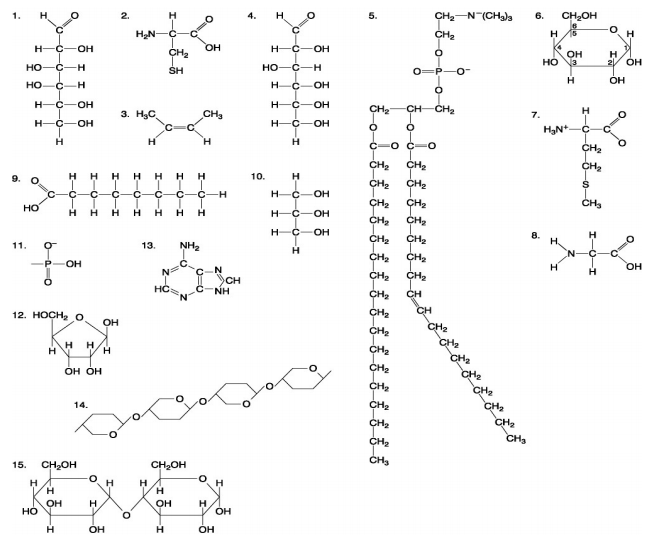
58. Based on the following 15 molecules, which of the following statements is NOT TRUE?
(A) 11, 12, and 13 could be linked together to form a nucleotide. (B) 5 is an important component of plasma membrane. (C) 2, 7, and 8 are molecules act as building blocks (monomers) of polypeptides. (D) 3 molecules of 9 and 1 molecule of 10 could be joined together to form a fat. (E) 11 and 13 could be joined together by a phosphodiester type of covalent bond.
59. About adrenal hormones, which of the following statements is NOT TRUE? (A) The adrenal medulla secretes catecholamines including epinephrine and norepinephrine. (B) Epinephrine and norepinephrine are secreted in response to stress-activated hormone cascade pathway via hypothalamus. (C) The adrenal cortex releases a family of steroids called corticosteroids in response to stress. (D) Humans produce two types of corticosteroids: glucocorticoids and mineralocorticoids. (E) Both glucocorticoids and mineralocorticoids play an important role in regulating blood pressure and volume.
60. Which description is correct about virus infectious diseases? (A) Human immunodeficiency virus (HIV) is a mosquito-borne retrovirus that cause acquired immunodeficiency syndrome (AIDS) of human. (B) Dengue virus has four serotypes that all are zoonoses pathogens that are transmitted from animal to human by vector mosquitoes. (C) Japanese encephalitis virus is a pathogen of zoonoses infectious disease that is transmitted between species from animal to human by vector mosquitoes. (D) H7N9 is an avian influenza virus also a subtype of influenza B virus. (E) Hepatitis B virus is a vector-borne virus that cause more than 80% infection in Taiwan.
61. Which option listed in below is INCORRECT that describe about "ATP synthesis"? (A) H+ ions flowing down their gradient enter a half channel in a stator, which is anchored in the membrane. (B) H+ ions enter binding site within a rotor, changing the shape of each subunit so that rotor spins within the membrane. (C) Each H+ ion makes one complete turn before leaving the rotor and passing through a second half channel in the stator into the mitochondrial matrix. (D) Spinning of the rotor causes an internal rod to spin as well. This rod extends like a stalk into the knob below it, which is held stationary by part of the stator. (E) Turning of the rod activates catalytic sites in the knob that produce ATP from AMP and Pi.
62. Birds and mammals both have negative pressure breathing, but birds are more efficient because of which of the following reasons? (A) The bird's mouth movements are able to force air into the lungs. (B) The tidal volume in birds is much larger than in a comparably sized mammal. (C) The flow of air in a bird's lungs is from posterior to anterior. (D) The brain of the bird maximizes oxygen uptake more efficiently. (E) The maximum PO2 is significantly higher in bird lungs.
63. Choose the INCORRECT description regarding the hearing system of human. (A) The cochlea can distinguish volume because the basilar membrane is not uniform along its length. (B) The ear conveys information to the brain about two important sound variables that are volume and pitch. (C) Three bones of the middle ear transmit the vibrations to the oval window. (D) The cochlea has two large canals, an upper vestibular canal and a lower tympanic canal, which separated by a smaller cochlear duct. (E) The hearing system of human is a mechanoreceptor system.
64. Which comment about "Global Climate Model" is INCORRECT? (A) Global climate patterns are determined largely by the input of solar energy and Earth’s movement in space. (B) Thermal energy from sunlight warms surface waters to whatever depth the sunlight penetrates, but the deeper waters reamin quite cold. (C) Many features in the environment influence microclimate by casting shade, altering evaporation from soil, or changing wind patterns. (D) Climatic variables affect the geographic ranges of most plants and animals, any large-scale change in Earth’s climate profoundly affect the biosphere. (E) Climate pattern can be modifed by many factors, including seasonal variation.
65. All of the followings have contributed to the diversity of organisms on the Hawaiian archipelago EXCEPT that (A) The islands are distant from the mainland. (B) Multiple invasions have occurred. (C) Adaptive radiation has occurred. (D) The islands are very young in geologic time. (E) Environmental conditions differ from one island to the next.
66. What is systems biology approach? (A) is to define gene curcuit and protein interaction network. (B) sequencing and analyzing whole genome sequence. (C) constructing a linkage map on the chromosome. (D) using bioinformatics tool to analyze gene expression and protein structure. (E) is attempt to integrate different levels of information in order to understand the operation of biological systems.
67. The following events are steps of neural transmission at a chemical synapse. Please choose the correct sequence of events. (1) Neurotransmitter binds with receptors associated with the postsynaptic membrane. (2) Calcium ions rush into neuron's cytoplasm. (3) The ligand-gated ion channels open. (4) An action potential depolarizes the membrane of the axon terminal. (5) The synaptic vesicles release neurotransmitter into the synaptic cleft. (A) 1 → 2 → 3 → 4 → 5 (B) 2 → 3 → 5 → 4 → 1 (C) 3 → 2 → 5 → 1 → 4 (D) 4 → 2 → 5 → 1 → 3 (E) 5 → 1 → 2 → 3 → 4
68. Most of the dry weight of a plant is the result of uptake of _____. (A) carbohydrates in the root hairs and concentration in the root cortex (B) water and minerals through root hairs (C) water and minerals through mycorrhizae (D) CO2 through stoma (E) CO2 and O2 through stomata in leaves
69. A researcher is trying to construct a molecular-based phylogeny of the entire animal kingdom. Assuming that none of the following genes is absolutely conserved, which of the following would be the best choice on which to base the phylogeny? (A) genes involved in eye-lens synthesis (B) genes that cause radial body symmetry (C) genes involved in chitin synthesis (D) collagen genes (E) beta-catenin genes
70. Carbon dioxide (CO
2
) is released during which of the following stages of cellular respiration? (A) oxidation of pyruvate to acetyl CoA and the citric acid cycle (B) glycolysis and the oxidation of pyruvate to acetyl CoA (C) fermentation and glycolysis (D) the citric acid cycle and oxidative phosphorylation (E) oxidative phosphorylation and fermentation
【已刪除】71. Species of amphibians belonging to the same genus occasionally mate, but their offsprings do not survive. This is an example of ______ (A) the postzygotic barrier called hybrid. (B) the prezygotic barrier called hybrid disjunction. (C) gametic isolation. (D) the postzygotic barrier called hybrid breakdown. (E) adaptative inviability.(本題送分)
72. A solution of starch at room temperature does not readily decompose to form a solution of simple sugars because ____. (A) starch hydrolysis is nonspontaneous (B) starch cannot be hydrolyzed in the presence of so much water (C) the activation energy barrier for this reaction cannot be surmounted (D) the hydrolysis of starch to sugar is endergonic (E) the starch solution has less free energy than the sugar solution
73. When an individual is subject to short-term starvation, most available food is used to provide energy (metabolism) rather than building blocks (growth and repair). Which hormone would be particularly active in times of food shortage? (A) antidiuretic hormone (B) insulin (C) epinephrine (D) glucagon (E) oxytocin
74. While sampling marine plankton in a lab, a student encounters large numbers of fertilized eggs. The student rears some of the eggs in the laboratory for further study and finds that the blastopore becomes the mouth. The embryo develops into a trochophore larva and eventually has a true coelom. These eggs probably belonged to a(n) ____. (A) arthropod (B) nematode (C) echinoderm (D) mollusk (E) chordate
75. How is habitat fragmentation related to biodiversity loss? (A) Populations of organism in fragments are smaller and more susceptible to extinction. (B) The tempature in fragments rises to cause biodiversity loss. (C) To keep biodiversity hot spot. (D) Less absorption of carbon dioxide by plants in fragments. (E) Environmental toxins are stable in fragments.
申論題 (0)
相關試卷
108年 - 108 學士後西醫:生物學#79182
108年 · #79182
105年 - 105 高雄醫學大學_學士後西醫:普通生物學#78613
105年 · #78613
104年 - 104 學士後西醫:普通生物學#27035
104年 · #27035
103年 - 103 學士後西醫:普通生物學#27047
103年 · #27047
101年 - 101 高雄醫學大學_學士後西醫學系招生考試試題:普通生物學#27447
101年 · #27447
100年 - 100 學士後西醫:生物學#27448
100年 · #27448
99年 - 學士後西醫生物學99生物#39211
99年 · #39211
98年 - 學士後西醫普通生物學98普通生物學#39361
98年 · #39361
97年 - 97 高雄醫學大學_學士後西醫:普通生物學#78694
97年 · #78694
96年 - 96學士後西醫生物#39066
96年 · #39066
 阿摩線上測驗
登入
阿摩線上測驗
登入
 (A) 11, 12, and 13 could be linked together to form a nucleotide.
(B) 5 is an important component of plasma membrane.
(C) 2, 7, and 8 are molecules act as building blocks (monomers) of polypeptides.
(D) 3 molecules of 9 and 1 molecule of 10 could be joined together to form a fat.
(E) 11 and 13 could be joined together by a phosphodiester type of covalent bond.
(A) 11, 12, and 13 could be linked together to form a nucleotide.
(B) 5 is an important component of plasma membrane.
(C) 2, 7, and 8 are molecules act as building blocks (monomers) of polypeptides.
(D) 3 molecules of 9 and 1 molecule of 10 could be joined together to form a fat.
(E) 11 and 13 could be joined together by a phosphodiester type of covalent bond.